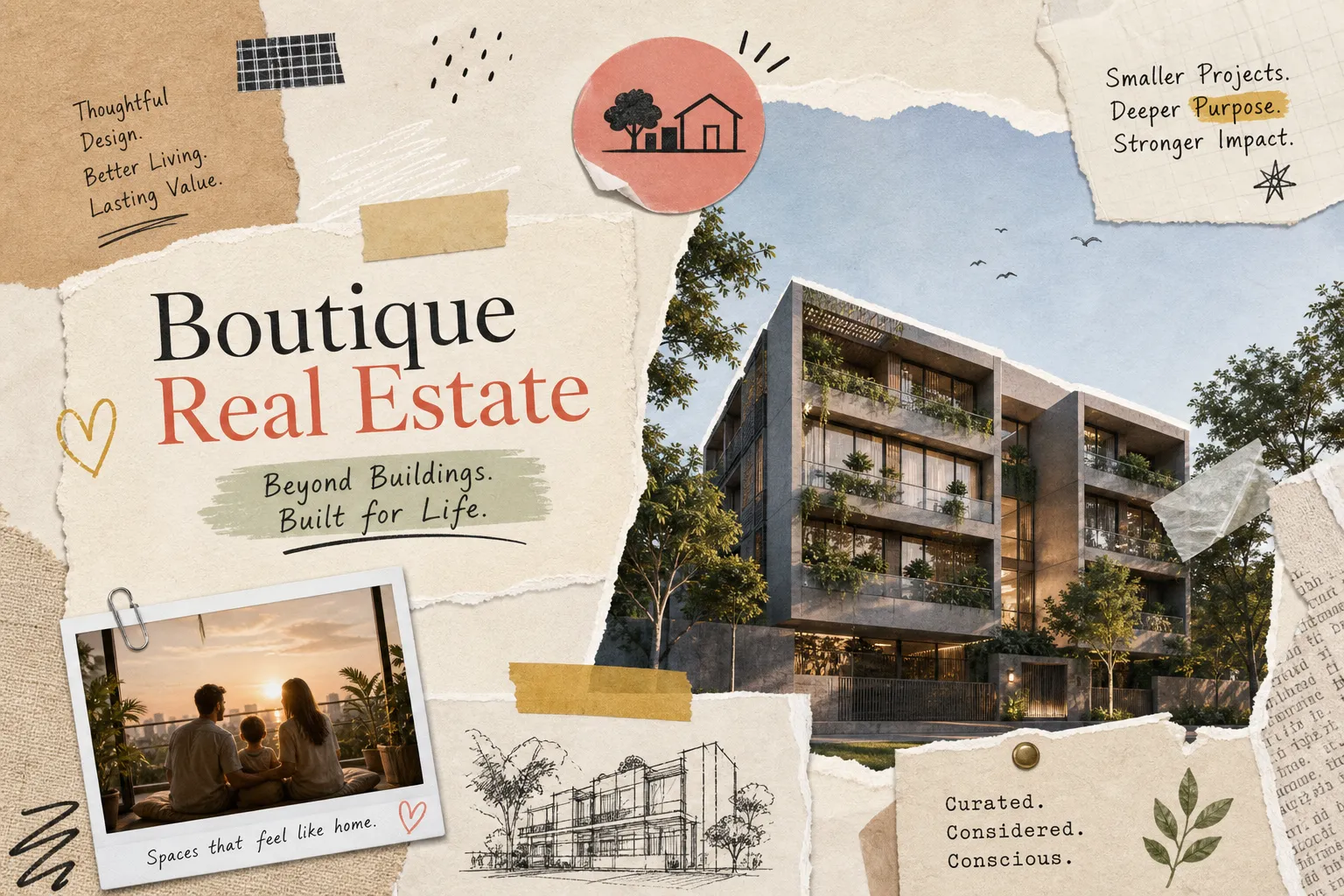
India’s luxury property market has matured considerably over the past decade, with HNI buyers increasingly asking a more pointed question than square footage or lobby grandeur can answer: who made this home, and why did they make it this way? That shift in question is precisely where a boutique real estate developer in India steps in, occupying a position that large-scale builders are structurally unable to fill. Where volume developers optimise for throughput, a design-led boutique developer optimises for the single project in front of them. The scale is deliberate, the process is personal, and the philosophy begins with the land rather than a floor-plate template.
Keshavaa, rooted in Goa, is a working illustration of this model. Treating each home as a handcrafted legacy rather than a transaction, the firm exemplifies what it means to build at boutique scale with genuine intent. The pages that follow explain what the boutique developer model is, how it works in practice, and why a growing number of discerning buyers are choosing it over the mainstream alternative.
The term “boutique developer” carries no formal legal definition in India. There is no regulatory threshold that grants or revokes the designation. What the term describes is a consistent cluster of operating characteristics: a limited number of active projects at any time, a focus on small-to-mid scale residential development rather than mass-market volume, and a design-led philosophy that prioritises customisation over replication.
In practical terms, a credible boutique residential developer in India is typically working on one or two active projects at once, not a broad multi-city pipeline. By most working estimates, a genuine boutique practice carries between one and five active projects and delivers homes in the range of twenty to one hundred units per project, positioned firmly in the upper-mid to luxury segment. These figures are illustrative rather than industry-standard benchmarks, but they reflect the operating reality that separates boutique scale from volume development. In North Goa’s premium enclaves, boutique luxury pricing currently runs from roughly ₹12,000 to ₹26,000 per sq ft depending on the micro-market, with Assagao and Candolim sitting toward the upper end of that range. In Mumbai’s prime zones, comparable pricing begins at around ₹35,000 per sq ft and climbs considerably higher. Recent Mumbai property rates provide a useful market reference for how prime-zone pricing behaves.
The most important thing to understand about boutique scale is that it is chosen, not inherited. A developer working on two projects at once is not simply one who hasn’t grown yet. The quality of execution they commit to cannot be sustained at volume. Maintaining close founder involvement, sourcing artisan materials selectively, and inspecting every detail of a build requires a pipeline small enough to allow it. That constraint is the entire point, and it is what separates a boutique developer from a small developer who simply lacks scale.
The boutique designation does not exempt a developer from regulatory rigour. Any credible bespoke property developer in India should hold a clean RERA registration history with properly filed project approvals and disclosed milestones. Under India’s RERA framework, projects exceeding 500 sq metres of land or more than eight apartments must register before any marketing or sale activity begins, with at least 70 per cent of buyer collections ring-fenced in a designated escrow account. These are baseline expectations, not optional signals of quality. For a concise primer on applicability and the registration process, see this quick guide to RERA applicability and registration.
Where large-scale builders run parallel projects across multiple cities with standardised processes and delegated decision-making, a boutique developer’s process is sequential, hands-on, and iterative. The same person who conceived the project is present when the stonework is laid and again when the buyer walks through for the first time.
At boutique scale, the founding principal remains directly involved across design, construction, and delivery. Decisions about materials, finishes, and spatial flow are not delegated to a project manager three layers removed from the client. This is not a branding claim; it is a structural consequence of the scale. When you are overseeing thirty homes rather than three hundred, direct involvement is not just possible; it is unavoidable.
The numbers make quality control different at boutique scale. A boutique developer can inspect every detail because the pipeline allows it, and their reputation depends entirely on it. Each completed home is a public portfolio piece that the developer’s name will be permanently attached to. There is no volume of other projects to dilute a failure; a single substandard delivery damages the entire body of work.
Boutique home builders working at this level place significant emphasis on locally sourced, contextually appropriate materials: stonework, handmade tile, reclaimed timber, laterite, lime plaster. These are illustrative of the palette a place-led developer might draw from, the specific choices vary by site, climate, and craft tradition. Sourcing such materials selectively takes longer than ordering from a standardised supplier catalogue, and the construction timeline extends accordingly. That extension is by design. The result is a building whose material character is specific to its place, rather than a generic luxury finish applied over standard concrete.
A design-led boutique developer in India does not begin with a floor-plate template and apply a luxury finish as a final layer. The design process starts with the site: its orientation, its natural light, its landscape, and the cultural context that surrounds it. Everything follows from that reading of the land.
Place-led design, in plain language, means that every spatial decision is made in direct response to the specific conditions of that site. Keshavaa’s Goa-rooted sensibility reflects this approach. The laterite contours of North Goa, the quality of monsoon light, the rhythm of local craft traditions, and the relationship between built volume and the surrounding natural environment are the kinds of site-specific conditions that inform every design choice from the first sketch, conditions that cannot be replicated by importing a standard catalogue of luxury features and applying them elsewhere. For readers interested in how this manifests in Goa, see the piece on why gated villas are dominating Goa’s luxury market.
There is a meaningful difference between a luxury finish applied at the end of a standard build and craftsmanship embedded in the construction process from day one. For design-led developers in India working at this level, quality is not an amenity layer; it is the structural logic of the entire project. The decision about which stone goes on a wall is made with the same level of intention as the decision about the wall’s position in space. These choices compound across a building and produce something that feels coherent in a way that premium-finish mass construction does not.
Homes built with clear architectural intention tend to hold and grow in value differently from those built to a market-average standard. Distinctiveness, durability, and material quality are not just aesthetic attributes; they are widely cited resale drivers among buyers and agents operating in India’s luxury property segment. Buyers who understand this are not paying a premium for aesthetics alone. They are acquiring an asset whose perceived value is reinforced by the scarcity and specificity of the decisions behind it. Industry commentary has observed how boutique luxury homes can gain advantage among India’s HNWIs, a point that reinforces the asset-case for design-led development.
A pattern that emerges consistently in conversations with HNI buyers navigating India’s property market is the distance between what a developer promises during the sales process and what the buyer actually experiences during and after construction. Boutique residential developers close that gap through a fundamentally different relationship model, one built around continuity rather than transaction.
For a niche real estate developer working at boutique scale, the client relationship begins before the purchase and extends well past handover. The buyer is not a unit count in a sales ledger. They are the person who will live in, or invest in, something the developer’s name is permanently attached to. That alignment of interest changes the nature of every interaction.
Boutique developers communicate differently from large builders. Site visits are personal and specific. Progress updates name the decisions that were made that week and why. The principal is reachable. For NRI buyers making high-value purchase decisions remotely, from the US, UK, or UAE, this quality of communication is not a courtesy; it is the foundation on which trust is built and maintained across time zones and without physical presence.
The strongest boutique developers in India offer guidance that extends beyond the transaction itself. Keshavaa’s advisory approach is one expression of this: engaging buyers on the investment rationale, the market context for Goa real estate, and where relevant, the rental or operational potential of the property. That breadth of engagement is possible only because the pipeline is small enough to give every client real, sustained attention. For a deeper look at current South Goa villa investment trends, prospective buyers often find it useful when assessing rental and operational potential.
The word “boutique” is used freely in Indian real estate marketing and it does not always reflect the operating reality behind it. When you begin shortlisting developers, the right approach is to ask direct questions and look for evidence, not claims.
Four questions separate developers with a credible boutique practice from those who simply operate at small scale:
The answers matter less than the ease with which they are given. A developer with a credible boutique practice answers these questions without hesitation because the evidence exists and is accessible.
Credible evidence looks like a portfolio of completed buildings, not renderings or ongoing construction. A clean and current RERA registration with disclosed and updated milestones matters. So does a documented handover timeline and a list of buyers who are willing to be contacted. Rather than three separate “it looks like” statements pointing in the same direction, consider this a single standard: delivery record and transparency are the two non-negotiables, and every other signal you evaluate should be read against those two. Advice on the benefits of boutique real estate can also help shape your checklist when evaluating developers.
Keshavaa’s approach in Goa offers a concrete illustration of what boutique development looks like when the principles described above are applied consistently: close founder involvement, a process that treats each home as a handcrafted legacy, and a client relationship built on transparency rather than transaction. For buyers ready to move past the shortlisting stage, the most useful next step is not reading further. It is arranging to visit a completed Keshavaa project in person and forming your own judgement about what the boutique model actually produces.
A boutique real estate developer in India is not defined by how small they are. They are defined by the deliberateness behind every decision: scale is chosen, the process is personal, design is anchored in place, and the relationship with the buyer outlasts the transaction. For HNI buyers who have moved past the checklist approach to luxury property, this is not a niche alternative. It is the standard they have been looking for.
The practical path from here is straightforward. Look at completed projects. Speak to the principal directly. Ask direct questions about timeline, materials, and post-handover accountability, then judge the quality of what was built with your own eyes, not through a brochure. If you are still torn between buying land vs a ready home in Goa, consult focused resources and visit comparable completions before deciding. That is how the boutique model earns its reputation, and it is how you verify it.