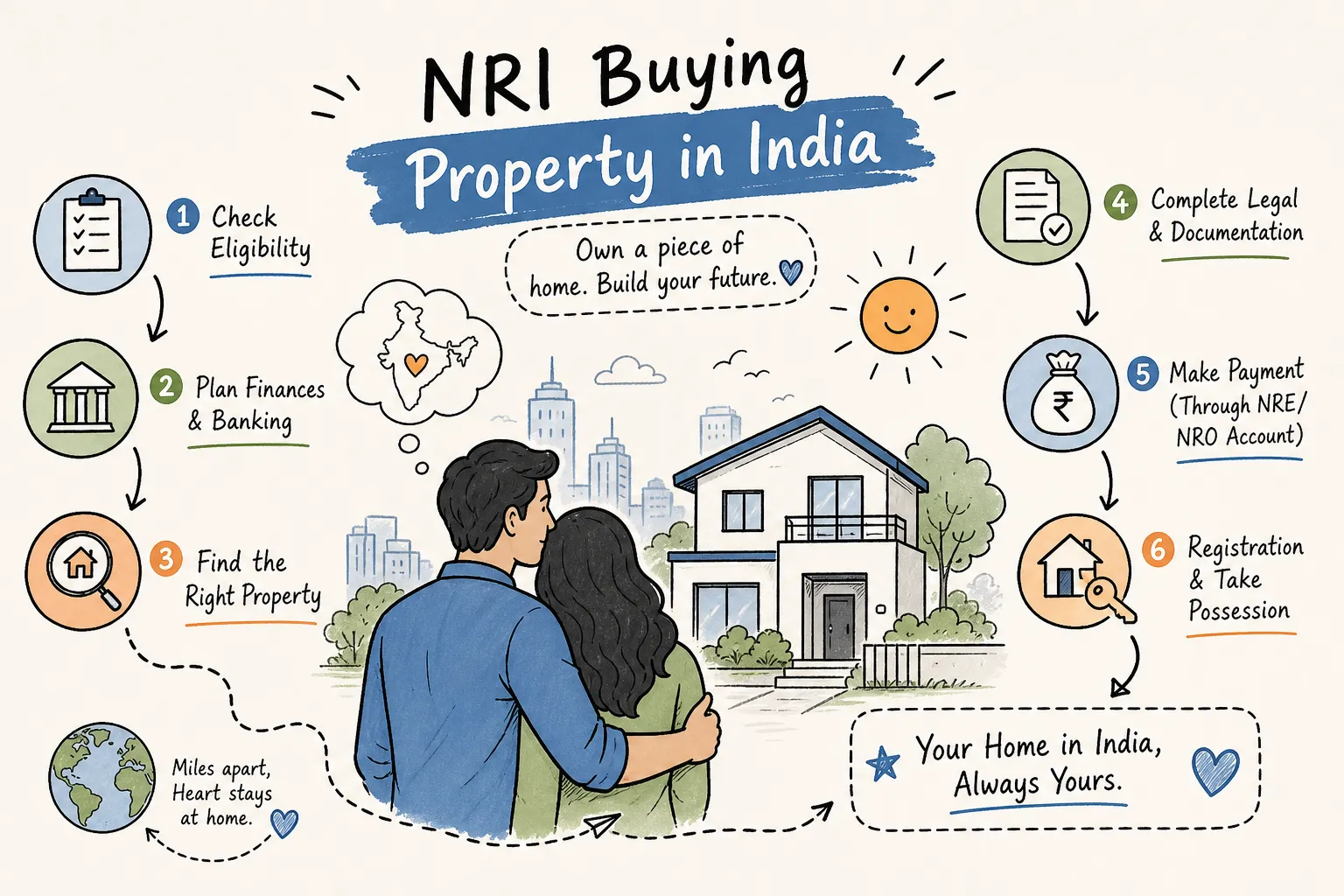
For NRIs looking to buy property in India, the opportunity is entirely real, but the process carries enough legal and financial layers that delays and costly missteps are common. Whether you are looking at a luxury retreat in Goa, a long-term investment, or a home for the family, the framework is consistent: understand the rules, structure the paperwork correctly, and choose people you can rely on from a distance.
This guide walks you through each step in plain terms: FEMA rules, funding routes, documentation, tax obligations, and due diligence. By the end, you will have a clear picture of how the entire process works for an NRI buyer, with full confidence and a clear view of every obligation ahead.
Under current FEMA and RBI guidelines, an NRI can purchase both residential and commercial property in India without requiring prior approval from the Reserve Bank of India. The transaction simply needs to be routed through permitted banking channels. This general permission covers apartments, villas, plots in approved layouts, and commercial spaces, which accounts for the vast majority of what NRI buyers are actually seeking. For a practical overview of how NRIs buy property in India, see the NRIs buying property in India guide.
Three categories remain firmly off-limits: agricultural land, plantation property, and farmhouses. This restriction is a FEMA limitation, not merely a bank policy, so it applies regardless of the lender or the state in which the property sits. If a developer or agent suggests a workaround for these categories, treat that as a serious red flag and disengage immediately.
NRIs may purchase from resident Indians, other NRIs, or OCIs, provided the transaction is FEMA-compliant and all documentation is in order. One practical point worth noting early: rental income from property held in India must typically be credited to an NRO account rather than an NRE account, which has direct implications for how you manage repatriation down the line.
The three accounts available to NRIs each serve a different money flow. An NRE account holds foreign earnings converted to rupees and is fully repatriable; it is the most straightforward source of funds for a property purchase. An NRO account holds income earned in India, such as rent or dividends, and is subject to stricter repatriation rules. An FCNR(B) account is a foreign-currency deposit that is also freely repatriable and can be used for permitted investments in India. For a clear breakdown of these account types, refer to a decoding NRE, NRO and FCNR accounts guide for NRIs.
For most NRI buyers funding a purchase from overseas savings, NRE or FCNR is the cleaner route. Using NRO funds is perfectly legal but requires more documentation to trace the source and manage the tax position. Maintaining a clean remittance trail from the outset, retaining proof of inward remittance such as Form A2 receipts, bank statements, and allotment letters, will simplify the process considerably when you eventually sell.
When you do sell, sale proceeds credited to your NRO account can be repatriated abroad up to USD 1 million per financial year across all your NRO accounts in India, per RBI guidelines. This requires a declaration under the Income Tax Act, along with a Chartered Accountant certificate in Form 15CB and a self-declaration in Form 15CA. If the original purchase was funded through NRE or FCNR, the repatriation position is generally stronger, provided the remittance trail has been well documented from the start.
The document checklist for an NRI purchasing property in India covers identity and status proof, financial trail evidence, and property-specific papers. At minimum, you will need the following before you can proceed to registration:
If the purchase involves a home loan, the lender will also require salary slips, employment contract, overseas bank statements, and sometimes an overseas credit bureau report. Requirements vary by lender, so confirm the full checklist early in the process rather than discovering gaps at the approval stage.
If you cannot be physically present in India to execute the purchase or handle registration, a Power of Attorney is the standard and legally recognised solution. A properly executed PoA allows a trusted representative in India to sign documents, appear before the registrar, and complete the transaction on your behalf. The PoA must be notarised in your country of residence and then either apostilled or attested by the Indian consulate, depending on which your country requires for documents intended for use in India; it must then be registered in India before use. Confirm state-specific stamping and registration requirements with a local property lawyer. Draft the scope carefully: it should authorise exactly what the transaction requires and nothing broader.
When an NRI sells property in India, the buyer is legally required to deduct TDS under Section 195 of the Income Tax Act before making payment. Following the July 2024 capital gains revision under the Finance Act, the base TDS rate for long-term capital gains on property held for more than 24 months is 12.5%, with the applicable surcharge and 4% health and education cess applied on top, making the effective rate meaningfully higher. For short-term gains, tax applies at the seller’s applicable income-tax slab rate, which can reach 30% before surcharge and cess. Unlike resident property transactions, there is no minimum threshold under Section 195, so TDS applies on the full sale consideration. For practical steps on TDS when an NRI sells property, consult a dedicated guide on Section 195 TDS on NRI selling property.
The NRI seller must file an Indian Income Tax Return for the year of sale, report the capital gain, and claim credit for any TDS already deducted. If TDS exceeds the final tax liability, the excess is refundable through the ITR process. Exemptions under provisions such as Section 54 may apply if conditions are met, which can materially reduce the tax outgo. For a broader look at tax implications and planning when NRIs sell property in India, see an NRI tax implications overview. An experienced Indian tax adviser is essential here, the interplay between TDS, capital gains rate, and repatriation documentation is one area where errors are expensive and hard to reverse.
NRIs can secure home loans from Indian banks and housing finance companies, with loan-to-value ratios typically ranging from 75% to 80% of the property value. Some lenders extend this to 85% or 90% depending on the applicant profile and their internal policy. Most lenders require a minimum of one to two years of overseas employment for salaried applicants, a satisfactory credit profile, and in some cases an Indian resident co-applicant.
Repayment must flow through NRE/NRO accounts or overseas remittance channels. Many lenders additionally ask for a Power of Attorney in favour of a resident Indian representative to handle local formalities during the loan process.
Due diligence for a remote NRI buyer demands greater rigour than for a resident buyer, given the practical distance from the property. Title verification should trace the property’s ownership history across multiple prior transfers, many lawyers recommend going back as far as practicable, or as local registrar practice dictates, to establish a clear chain of title and confirm there are no encumbrances or pending litigation. Verify that the project is registered under RERA in the relevant state and that the developer’s registration is current; state RERA portals allow you to check registration numbers and project status directly. Check for approvals such as the commencement certificate and occupancy certificate at the appropriate construction stages. Appoint an independent property lawyer in India rather than relying solely on the developer’s legal team, and ensure that payment terms are structured to protect your interests throughout the construction cycle.
The legal steps above are navigable. The harder part, for most NRIs, is trusting that the developer will execute with integrity when you are not in the same time zone, let alone the same country. The qualities that matter most are not marketing materials or show-flat finishes. They are track record, RERA compliance, transparent payment structures, and a relationship-driven advisory model that keeps you informed at every milestone without you having to chase updates.
A boutique developer like Keshavaa, founded in 2008 and rooted in Goa, is built specifically around this need: end-to-end client support from the first conversation through to operations, transparent stewardship of your investment, and a process that treats each home as a handcrafted legacy rather than a unit to be moved. The boutique scale means your purchase is not a file in a queue; it is a relationship with a developer who understands that buying from abroad requires an exceptional standard of clarity and accountability. For NRIs evaluating luxury property in Goa, that combination of design sensibility, generational value philosophy, and genuine NRI Investment focused service makes the remote buying process far less daunting than it would be with a large-scale developer. If you are specifically considering coastal options, read our practical notes on buying a beach house in South Goa to understand on-the-ground considerations.
Purchasing property in India as an NRI requires you to get three things right: legal compliance under FEMA, a well-structured financial trail through the correct accounts, and a developer relationship anchored in transparency. None of these steps are prohibitively complex once you understand the framework, and with the right legal and financial advisers alongside you, the process is entirely manageable from abroad.
The most consequential decision you will make is not which city or which configuration. It is who you buy from. A developer with a track record of honest dealings, RERA compliance, and genuine support for remote buyers removes most of the risk that makes buying property in India as an NRI feel uncertain. If a boutique luxury home in Goa is part of your long-term vision, explore what Keshavaa has built and, more importantly, how they build it. Ask to see completed projects, their RERA registration history, and how they have supported past NRI buyers; for guidance on choosing between plot purchase and a ready home, see this discussion on buying land vs a ready home in Goa, the answers will be telling.