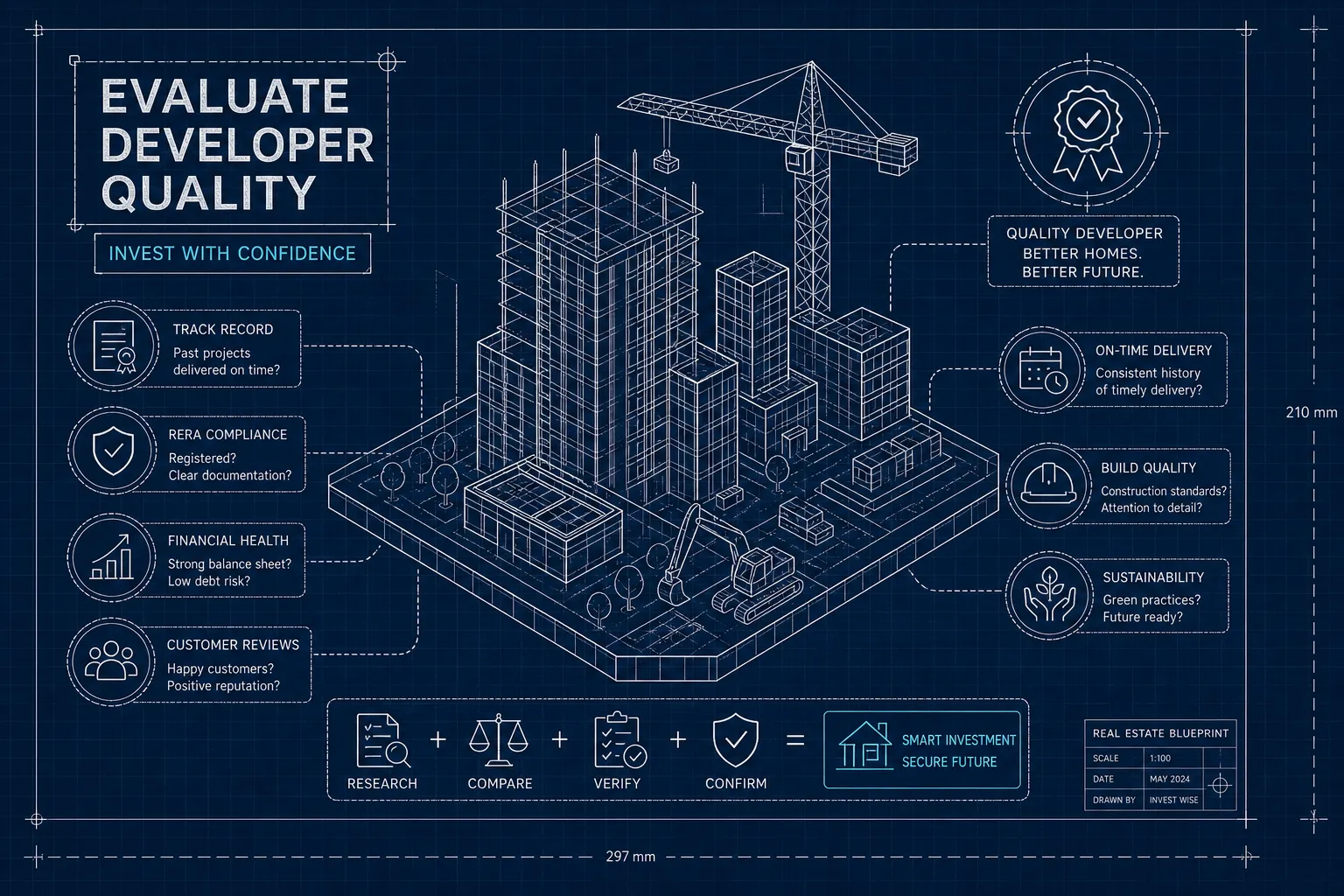
When assessing developer quality in India, most buyers are handed photography, floor plans, and promises. Very few are shown evidence. India’s luxury real estate market has produced genuinely extraordinary homes and cautionary headlines in equal measure, and for any discerning buyer, whether an HNI based in a metro or an NRI purchasing remotely from the US or UAE, the challenge is knowing how to separate the two before signing anything.
There are specific, verifiable benchmarks that distinguish developers of genuine quality from those who merely perform it. This article gives you a practical framework to evaluate real estate developer quality in India, grounded in verifiable criteria rather than marketing language. By the time you finish reading, you will have the right questions to ask and the right records to request before committing to anything.
The Real Estate (Regulation and Development) Act, 2016 requires developers to register projects with the relevant state authority before advertising, booking, or selling units. Under the Act, registration mandates public disclosure of layout approvals, project timelines, payment schedules, and financial information. Developers must deposit 70% of buyer collections into a dedicated escrow account, used exclusively for construction and land costs on that registered project, a provision designed to prevent funds from being diverted to other ventures.
To verify a developer’s RERA status, visit the official state RERA portal for the state where the project is located. Search by project name, developer name, or registration number. Confirm that the registration is active, the project status is accurately reflected, and the registration number in sales brochures matches the portal record exactly. If you are purchasing a phased development, verify that your specific phase is registered separately where required.
What RERA does not address is equally important: it governs disclosures and timelines, not construction quality, material sourcing, or craftsmanship. A developer can satisfy every RERA obligation and still deliver a property that disappoints. RERA is the legal baseline. Evaluating the quality of a developer in India begins where RERA ends, and the criteria that follow matter far more to buyers seeking a home that holds its character and value across decades.
Consistent on-time delivery across multiple completed projects is the single most reliable indicator of a developer’s operational credibility. Request possession certificate dates for past projects and cross-reference them against the originally declared timelines. A developer who has delivered six projects within their committed schedules, through post-COVID slowdowns, GST transitions, and demonetisation-era disruption, is demonstrating something that no marketing campaign can manufacture.
Completion certificates and occupancy certificates confirm that construction was finished according to approved plans and that the building is structurally safe and fit for habitation. A possession letter, by contrast, is evidence of transfer of possession, not proof that the building is legally ready to occupy. Delays in obtaining completion or occupancy certificates can indicate financial strain, site management failures, or approval complications. Be particularly cautious of developers whose portfolio consists entirely of launched-but-undelivered projects. Pattern recognition across a portfolio matters far more than one showpiece development.
According to Keshavaa, the company has spent close to two decades delivering handcrafted homes in Goa under the same founding philosophy and with the same commitment to artisanal detail. If accurate, this kind of sustained execution, consistent across an evolving market and shifting economic conditions, represents exactly what a serious buyer should look for in any developer’s history.
Most buyers experience a developer’s quality through a furnished show flat. This is an unreliable indicator. Show flats are designed to impress; they are not representative of a typical unit’s fit and finish. A serious buyer should request a site visit to a project under construction or one completed within the past two or three years. Observe the concrete work directly, inspect the waterproofing details, examine the plumbing layout, and assess the finishing quality at close range.
Specific things to examine during a site visit include: the sharpness of corners and wall junctions, the consistency of tile laying, the quality of door and window frames, the finish on plaster surfaces, and the absence of visible seepage stains or patch repair marks. These details reveal far more about a developer’s site supervision standards than any specification document.
For structural assurance, buyers can engage a third-party structural engineer to assess a completed or ongoing project independently. Developers who permit and actively encourage independent inspections make verification straightforward; a refusal or pattern of deflection should be investigated further. Genuine construction quality also starts at the design stage, not the finishing stage. Developers who invest in rigorous architectural drawings and detailed site supervision produce buildings that perform and age differently from those where design is treated as an afterthought.
A project specification document should state, clearly and without ambiguity: the grade of concrete used in structural elements, the steel specifications, the waterproofing membrane type, flooring material brands and grades, sanitary fixture brands, window frame materials and performance ratings, and the electrical load capacity for each unit. Most reputable developers will provide this document on request before any booking. A developer who is vague, evasive, or who offers verbal commitments only is signalling that the written record will not support their claims.
Large-volume developers typically purchase materials in bulk for cost efficiency. This means standardised finishes across hundreds of units, chosen for procurement economics rather than for the specific home being built. Boutique developers take a different approach, sourcing materials with the project’s design intent in mind. Keshavaa’s stated philosophy of earth-sourced materials and artisanal detailing reflects what considered sourcing can look like: natural stone selected for a particular space, handcrafted joinery commissioned for a specific volume, locally sourced elements chosen because they belong to the home rather than because they were cheapest at scale.
Premium materials, properly installed, do not just look better at handover. They perform better over ten, twenty, and thirty years. For a buyer treating a luxury home as a legacy asset, this matters in measurable terms: stronger resale value retention, lower long-term maintenance liability, and a building that ages with dignity rather than one that requires constant remediation.
Most developer websites feature curated testimonials. The question is not whether the feedback is positive but whether it is independently verifiable. Look for testimonials that carry full names, project references, and handover years. Cross-reference what you read on a developer’s website with Google reviews, housing portal reviews, and resident association forums associated with their completed projects. Selective editing is easy; a consistent body of independent feedback across multiple platforms is considerably harder to manufacture.
Ask for direct references from people who already live in the developer’s completed projects and speak to them with specific questions. Was the handover on time? How did the developer respond to snagging issues in the first six months after possession? Were the delivered specifications consistent with what was promised at booking? Did the building perform through its first monsoon without seepage or structural complaints? These questions surface information that no brochure will reveal.
A developer who remains engaged after handover, addressing defects, maintaining common areas, and honouring structural warranty claims, demonstrates a fundamentally different philosophy from one who disappears post-possession. For NRI buyers who cannot be physically present to manage issues, this post-sales character is not a secondary consideration. It is central to the ownership experience.
The following five criteria are worth treating as non-negotiable in any developer evaluation:
Several red flags warrant serious caution: resistance to a site visit, verbal-only material commitments with no written specification, a portfolio of only launched-but-undelivered projects, unwillingness to provide client references, and pricing that sits significantly below comparable boutique developers in the same market. In India’s luxury segment, pricing that appears implausibly low for the quality being promised can be a warning sign that warrants deeper due diligence.
Bring these questions directly into a developer meeting and observe how they respond:
A developer confident in their quality will answer every one of these questions without hesitation. Deflection, delay, or redirection towards glossy presentations in place of direct answers is itself a data point worth noting.
Real estate developer quality in India is not invisible. It is evidenced. It shows up in RERA filings, possession and occupancy certificates, material specifications, site conditions, and the candid feedback of people who already live in the homes being offered to you. The buyers who make sound decisions are the ones who seek out that evidence rather than accepting the presentation at face value.
At Keshavaa, the company describes its history as a body of completed work delivered under a consistent philosophy of artisanal quality and generational value, with a client relationship it maintains beyond possession. That is the standard this article has outlined. Apply the same scrutiny to any developer you are considering.
If you are evaluating a luxury property in Goa, a conversation with Keshavaa begins with a site visit, not a sales pitch. Visit a completed home. Ask the hard questions. The answers will tell you everything.