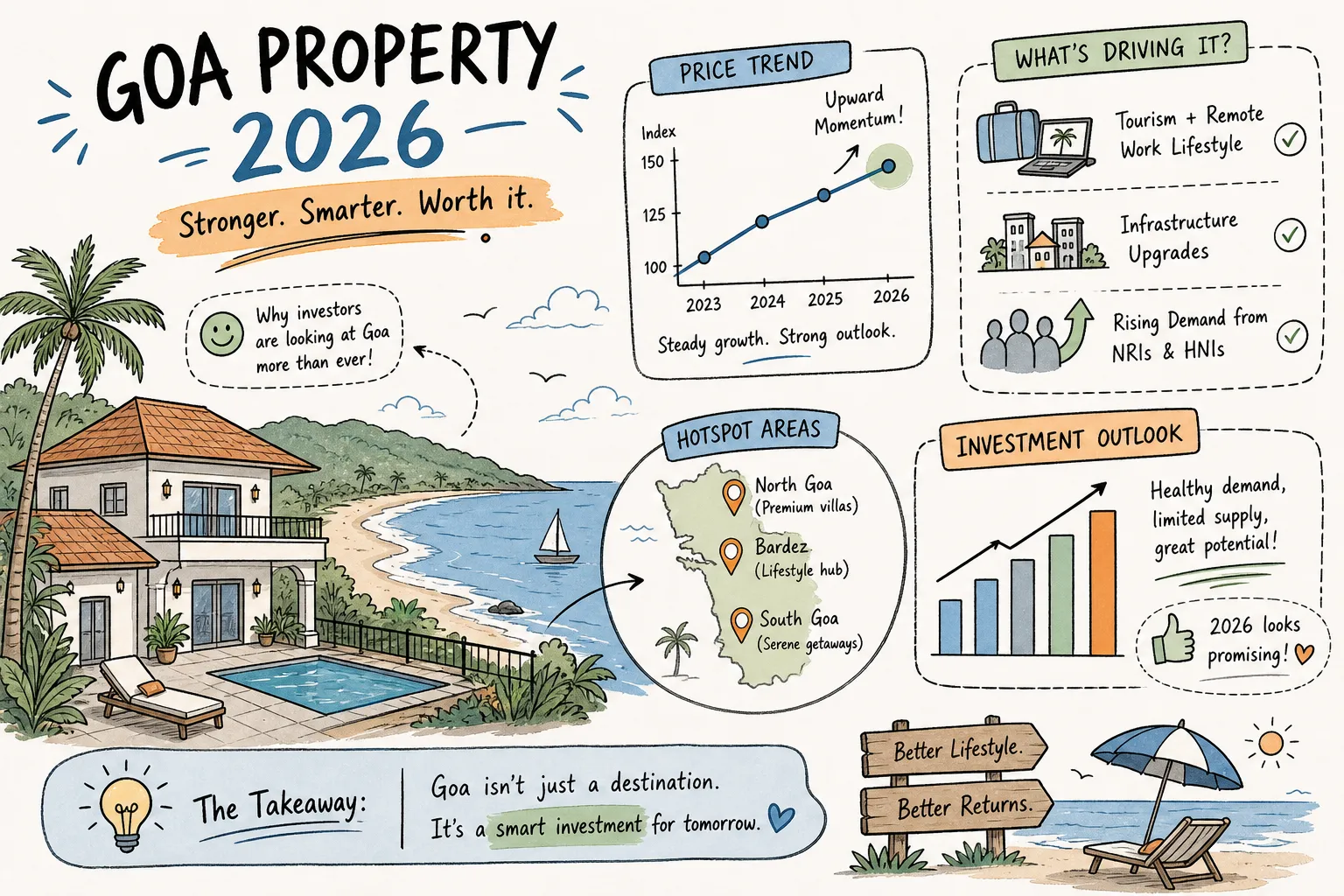
The Goa property market has moved well past its post-pandemic surge. What once read as a collective mood shift, driven by remote work, lifestyle reappraisal, and holiday-home sentiment, has hardened into something more deliberate. Buyers entering this market in 2026 are not chasing a trend. They are making a considered allocation: a coastal asset with structural supply constraints, improving infrastructure, and a demand profile that now spans metro HNIs, returning NRIs, and boutique hospitality investors with long time horizons.
That maturity is visible in transaction volumes, in the micro-market premiums that have held through successive rate cycles, and in the track record of developers who have been present through multiple phases of this market’s evolution. Keshavaa, rooted in Goa’s luxury segment since 2008, has tracked this market through each of its phases, from seasonal indulgence to core portfolio conversation. Close to two decades of boutique development in this specific market speaks to how deep the fundamentals here actually run.
This article offers a clear-eyed read of where prices sit in 2026, which micro-markets deserve serious attention, what rental income realistically looks like, and what HNIs and NRIs need to weigh before committing capital.
Demand is no longer seasonal or sentiment-led. The buyer profile has shifted decisively: second-home enquiries from Delhi, Mumbai, and Bengaluru have converted into consistent transaction volumes, and NRIs based in the US, UK, and UAE are engaging with Goa as a rupee-denominated asset with genuine appreciation credentials. These buyers are operating with 7, 10-year ownership horizons, not the two-year flip logic that characterised earlier cycles. Recent reporting also highlights how younger professionals are increasingly allocating to villa properties in Goa as an income or lifestyle play, reinforcing the changing buyer profile. young professionals are now investing in villa properties.
Infrastructure has played a meaningful role in this shift. The Manohar International Airport at Mopa is operational and actively expanding North Goa’s catchment. The Porvorim Elevated Corridor, completing in April 2026, has compressed commute times between Panaji and North Goa’s lifestyle localities, making year-round access a practical reality rather than a seasonal convenience. These are documented, traceable price drivers, and buyers should map their target locality against proximity to both nodes.
The supply side has not kept pace, and this is partly by design. Coastal Regulation Zone (CRZ) and No Development Zone (NDZ) rules continue to limit what can be built near the shoreline, and environmental clearances for large-format projects move slowly. The practical effect is that compliant, titled inventory in beach-adjacent and heritage-sensitive localities is genuinely scarce. This structural constraint acts as a floor under values, and it explains why boutique developers with clear land titles and a history of navigating Goa’s regulatory environment command a disproportionate premium in this market.
North Goa carries the widest pricing band in the state. Calangute ranges from ₹8,600 to ₹18,400 per sqft for flats, reflecting mixed inventory across the tourist belt. Candolim sits at ₹8,000, ₹12,000 per sqft for apartments, steadier in character and backed by consistent long-stay demand. Panaji registers around ₹12,219, ₹16,028 per sqft depending on source and property type (see Panaji property rates for published locality rates), while Taleigao, which benefits from its proximity to Panaji and improving connectivity, sits at approximately ₹10,332 per sqft.
Assagao is in a category of its own. Goa’s most sought-after luxury village market now commands ₹15,000, ₹30,000 per sqft for villas, a premium that reflects land scarcity, the concentration of design-conscious buyers, and the lifestyle address the locality has built over the past decade. This is not a generic North Goa price; it is a specific premium for a specific kind of product.
For a focussed neighbourhood-level view of high-end pockets, see our Best Areas in Goa for Luxury Property Investment guide, which breaks down product types and what buyers should expect from each micro-market.
South Goa inland pockets, including Margao, sit in the ₹4,500, ₹9,500 per sqft range, making them the most accessible entry point in the state. South Goa’s boutique coastal belt, covering Cavelossim, Benaulim, Palolem, and Agonda, is improving on infrastructure and drawing selective luxury interest, though it does not yet match North Goa’s rental intensity. For buyers prioritising long-term capital appreciation over near-term income, South Goa offers a quieter, lower-entry-cost position with structurally lower oversupply risk.
Villas have led appreciation decisively across segments. North Goa villa capital values rose 28% year-on-year in 2024; by 2026, select premium pockets recorded price movements of up to 66%. Apartments have appreciated more steadily. Land has been the most volatile asset class: collector-rate revisions in Bardez and Pernem saw rates move from ₹3,000 per sqm to ₹8,000 per sqm in 2024, 25, and Pernem plots have shown 27, 30% annual growth following the Mopa airport effect.
When weighing North against South for a specific allocation, a detailed side-by-side consideration helps. Our North Goa vs South Goa: Where Would Smart Investors Put ₹2Cr? piece examines trade-offs between rental intensity, appreciation potential, and lifestyle preference to help align buyer intent with the right micro-market.
Assagao, Siolim, Anjuna, Arpora, Morjim, and Vagator consistently top demand lists for both owner-occupiers and rental-income buyers. Assagao and Siolim draw buyers who want village character, design-conscious architecture, and proximity to North Goa’s dining and cultural scene without sitting on the beach belt itself. These localities attract a particular kind of buyer: one who has moved past the obvious and is looking for a home with genuine spatial and aesthetic intention.
Anjuna, Arpora, Morjim, and Vagator suit buyers who want immediate rental potential. These localities carry deep brand recognition among both domestic and international travellers, which underpins short-term rental demand through the peak season. For a buyer whose income case depends on occupancy, these addresses have proven track records and are not speculative bets.
The Mopa corridor, covering Pernem and the emerging north, is a different proposition entirely. This is the segment for buyers with a 5, 7-year horizon, willing to accept less immediate rental liquidity in exchange for a lower entry price and strong structural tailwinds from infrastructure completion. The GMR Aerocity project near Mopa is in early stages but already influencing land values in surrounding areas. Buyers entering Pernem now are pricing in anticipated infrastructure; those who entered two years ago have already seen material price gains, based on the 27, 30% annual growth recorded in this corridor.
South Goa suits a specific buyer: one who prioritises privacy, exclusivity, and a slower pace over rental optimisation. Cavelossim, Benaulim, and the Agonda belt are drawing boutique villa developers and individual buyers who find North Goa’s density increasingly crowded. Appreciation here is steadier, and the risk of oversupply is lower precisely because fewer developers are active in this segment. For buyers building a legacy asset rather than an income vehicle, South Goa’s quieter trajectory has its own logic.
Rental yields in Goa’s residential market fall into distinct bands. Well-located, well-managed villas in grade-A localities deliver 5, 8% gross yield. Highly optimised premium assets in tourism-heavy pockets, Anjuna, Calangute, Vagator, and Morjim, can reach 10, 12% gross in strong years. Apartments in Porvorim, Panaji, and Dona Paula attract steadier long-stay tenants, with monthly rents of approximately ₹20,000, ₹35,000 for 1, 2 BHK units. Premium apartments in these pockets have shown 8, 10% annual appreciation in 2026, making the total return case reasonably sound even where rental yield is more moderate. Independent market reporting has tracked residential rental yields in Goa, supporting these observed bands; see contemporary yield reporting for context on gross yield baselines. Goa residential rental yield reaches 5.8%.
The seasonality reality deserves honest treatment. Average Airbnb occupancy in Goa sits at approximately 49% annually, with specific localities such as Anjuna at around 32% in recent data, reflecting the depth of the off-peak trough. Peak-season months, November through February, drive disproportionate revenue, and buyers who project year-round occupancy at peak-season rates will be disappointed. The income case works when the property is managed as a hospitality asset with a professional operator. Passive income without active management and a genuine understanding of the tourism calendar is not the right frame for this market.
For NRI buyers, the dollar-to-rupee differential is a tangible part of the return calculation. Many NRI investors view Goa’s luxury segment as competitively priced in foreign-currency terms, an assessment that holds particular weight for buyers planning to hold over a decade or repatriate rental income over time. That said, a like-for-like comparison with coastal markets in Southeast Asia or southern Europe will depend on the specific markets being compared, and buyers should model this against their own currency exposure and repatriation plans rather than relying on a general benchmark.
CRZ restrictions remain the single biggest constraint on new supply in Goa’s most desirable localities. Properties within 500 metres of the high-tide line require careful scrutiny: buyers should verify CRZ status, land-use approvals, and environmental clearances before proceeding. NDZ rules further limit what can be built in ecologically sensitive areas, and new launches in these zones require clearances that can take years to materialise. This is not merely bureaucratic inconvenience; it is the regulatory mechanism that constrains new supply and, in doing so, supports long-term values.
On the transaction-cost side, Goa’s stamp duty structure in 2026 is slab-based for resident buyers: 3.5% up to ₹50 lakh, rising to 5% above ₹1 crore, with a registration fee of 3, 3.5% depending on the slab. NRIs pay the same stamp duty and registration charges as resident buyers, with the key additional considerations being TDS on the transaction and FEMA-compliant fund routing through NRE, FCNR(B), or NRO accounts. Under FEMA’s general permission route, NRIs do not require prior RBI approval to purchase residential property in India; the prohibition applies specifically to agricultural land, plantation property, and farmhouses. For practical guidance on stamp duty and registration charges in Goa, see a contemporary overview of stamp duty and registration charges in Goa.
Title due diligence in Goa remains essential and sometimes complex. Agricultural land misclassified as residential, ancestral ownership disputes, and encumbered plots are documented risk factors in this market. Verifying RERA registration, land-use conversion, and clear title history through a qualified local advocate is not optional; it is the baseline for any serious buyer.
The clearest pattern among HNI and NRI buyers entering the Goa property market in 2026 is a preference for proven micro-markets, transparent developers, and compliant, titled land. Buyers with a legacy or second-home intent are prioritising boutique developments with handcrafted design quality and long-term asset character over high-density apartment complexes. In this market, what you buy matters as much as where you buy it.
The risks are worth naming plainly. CRZ complications can delay or stall projects. Rental income projections need stress-testing against off-peak occupancy realities. Land prices in Mopa-corridor pockets have risen sharply, and buyers entering now are paying for anticipated infrastructure, not existing demand. The market has appreciated significantly across multiple segments, and buyers targeting short-term exits in an already-appreciated market carry materially more risk than those entering with a 7, 10-year ownership mindset. For readers seeking context on why the cost of real estate in Goa is rising, that analysis outlines the regulatory and demand-side drivers that underpin current valuations.
Developers with a multi-decade track record in this specific market carry a credibility premium that is difficult to replicate. Keshavaa, which has been developing in Goa’s luxury segment since 2008, brings precisely the depth of local knowledge and project history that serious buyers look for when committing to a high-value asset in a market where transparency and regulatory fluency are not easily found.
The Goa property market in 2026 is not a fringe play or a seasonal indulgence. It is a mature, multi-layered market, one where structural supply constraints, documented infrastructure investment, and evolving Goa property trends in 2026 converge to create a compelling case for the considered buyer. Those who navigate it well bring clarity on their intent, whether that is a legacy home, rental income, or portfolio diversification, alongside a sound understanding of the regulatory environment and a clear-eyed view of the developers they choose to work with.
Use this overview as a framework, not a substitute for specific due diligence. Locality prices shift with new data, CRZ status needs verification at the plot level, and the income case for any individual property depends on its specific location, design quality, and operational model. The broad picture of the Goa real estate market is clear; the detail is where the decisions are made.
If you are exploring Goa’s luxury residential segment, Keshavaa’s advisory process is grounded in close to two decades of development in this market, a focus on handcrafted quality, and a structured approach to the kind of transparent, relationship-driven guidance that discerning HNI and NRI buyers seek. Reach out to begin a considered conversation about what the right Goa position looks like for your specific objectives.