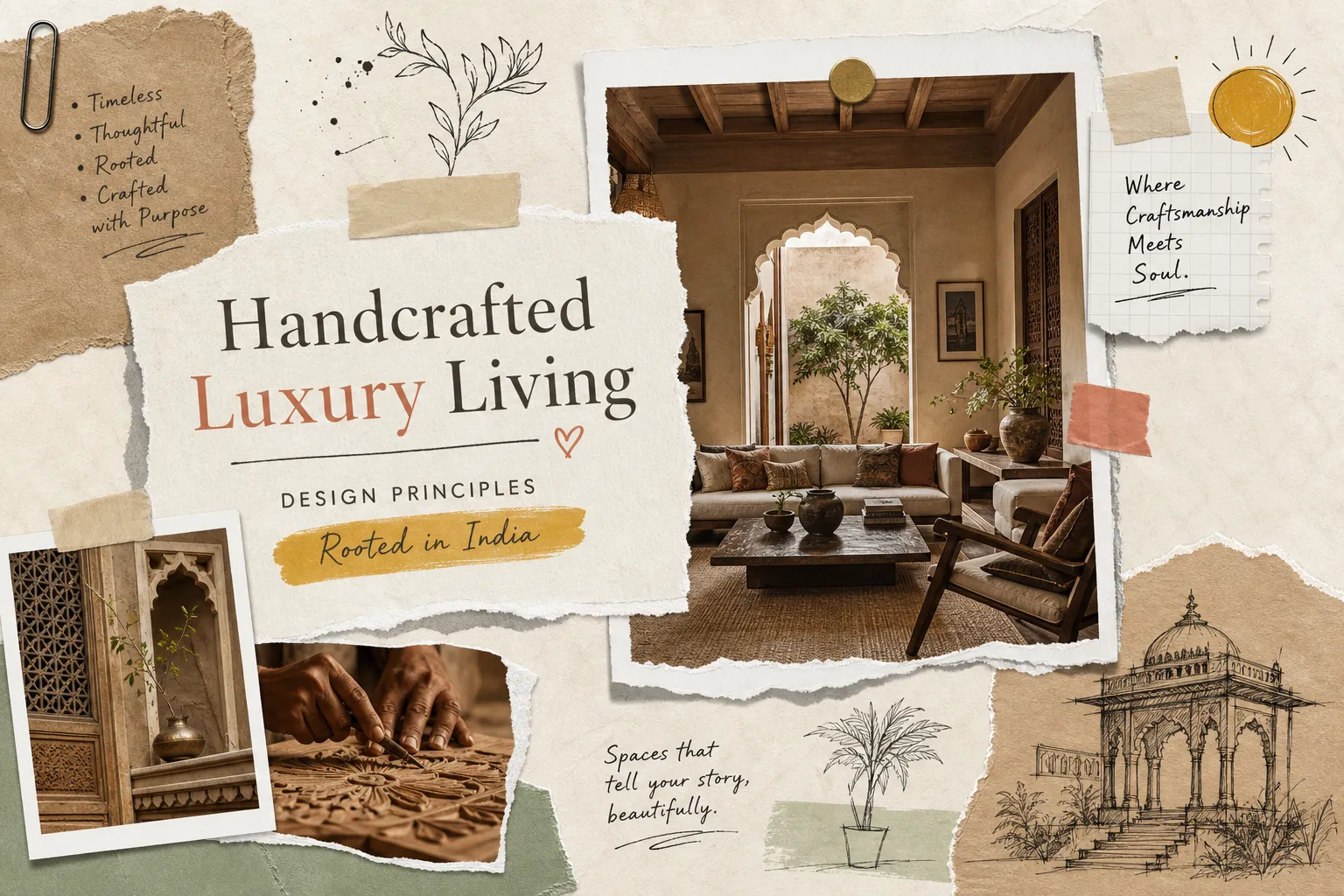
Handcrafted luxury home design principles in India begin with a single, disciplined question: why? Why this material, why this proportion, why this view from that window at that particular hour of the morning. A luxury home impresses. A handcrafted one endures. The difference is not price per square foot, or the brand of stone on the kitchen counter. It is the intention behind every decision.
If you are commissioning a bespoke home in India, or selecting a developer whose work you trust to carry your brief faithfully, you need a working vocabulary before you brief anyone. The nine principles covered in this article are that vocabulary. They apply whether you are working with an architect in Mumbai, an interior designer in Bengaluru, or selecting finishes for a Goa villa from a studio in London.
Keshavaa, a boutique luxury developer rooted in Goa, has built its design philosophy around these principles. The firm’s founder treats every home not as a unit to be sold, but as a handcrafted legacy to be made. That distinction shapes everything that follows.
Many premium constructions in India tend to prioritise specification sheets over spatial experience. They use marble because marble signals luxury, install imported fittings because the catalogue shows them in aspirational photography, and maximise built-up area because more square footage justifies a higher asking price. The result is an expensive home. It is not, by any meaningful definition, a handcrafted one.
Handcrafted luxury home design in India is defined by design intention: every material, proportion, and finish is chosen because it solves something, for the climate, for the occupant, for the site. A handcrafted home uses a specific laterite stone not because it looks rustic, but because its thermal mass helps moderate interior temperatures in a coastal Goan summer with less reliance on mechanical intervention. That is a considered decision. It is also, over decades, a better one.
Boutique developers can embed this kind of intention at every stage precisely because they are working on a handful of homes at a time. A large-scale developer building two hundred units simultaneously cannot make individual decisions about ceiling height, door hardware, or where morning light should enter a bedroom. A firm like Keshavaa, working at boutique scale, structurally can. That is not a marketing point; it is an operational reality with direct consequences for the quality of the finished home.
Design intention means nothing in a home is arbitrary. The height of a threshold, the depth of a verandah overhang, the weight of a door handle, each carries a reason. In craft-led architecture in India, this discipline is not new. It is the inherited logic of builders who worked with climate, material, and community long before trend boards existed: the Chettinad masons who calibrated courtyard proportions for cross-ventilation, the Goan Baroque craftsmen who resolved European form with tropical material, the Rajput builders who made stone a thermal instrument.
The distinction matters practically. A premium home may use Carrara marble because it photographs beautifully. A handcrafted home might choose Makrana marble from Rajasthan for its warm undertones, its belonging to the subcontinent’s stone tradition, and the way it weathers into the specific quality of light in that space over time. One decision is cosmetic. The other is architectural.
Indian luxury residential design has never existed in isolation from its cultural and ecological context. A courtyard’s dimensions, the deliberate placement of a threshold, the angle of a carved screen filtering afternoon light, these are not decoration. They carry spatial memory, climate intelligence, and cultural identity. A home designed without that context, however expensively finished, is simply costly. Not bespoke.
The nine principles below are the framework that protects this philosophy in practice. In a home built around them, every specification decision can be traced back to an intention, and that traceability is what separates a home with a philosophy from one with merely a price tag.
Whether you are briefing an architect, reviewing a developer’s portfolio, or deciding whether a finished home is worth its asking price, these principles are the questions to ask. They are organised here in three thematic clusters. For a complementary perspective on essential home design principles for the Indian lifestyle, see this overview of essential home design principles for Indian lifestyle here.
Spatial planning and flow means the floor plan is drawn around how people actually move and live, not around maximising carpet area on a sales brochure. Rooms connect intuitively. The plan has a logic the body understands before the mind articulates it. Natural light and ventilation follow from this: courtyards, verandahs, deep overhangs, and strategically placed openings are not stylistic choices. They are traditional Indian solutions to airflow and daylighting that outperform mechanical alternatives in both comfort and longevity. No air-filtration system replaces a well-placed courtyard.
The third principle in this cluster, indoor-outdoor living, is especially non-negotiable in coastal and tropical climates. In Goa, the distinction between built and open dissolves naturally when a home is designed to welcome it. Terraces, garden connections, and threshold spaces are not amenities; they are the architecture of place. A home that closes itself off from its site is a missed opportunity that no interior finish can recover.
Handcrafted homes choose materials for their honesty. Teak for its grain, durability, and response to carving. Laterite for its thermal qualities and its belonging to the Goan landscape. Stone for its permanence. Artisanal detailing in this context is not decoration applied to a surface; it is the mark of a maker working with a material’s natural properties rather than against them. This is what distinguishes artisan home design from premium construction with decorative finishes.
Functionality sits alongside beauty as a principle of equal weight. Luxury is not comfortable if it is impractical. Beautiful surfaces that require specialist care unavailable locally, or spatial gestures that create acoustical or thermal problems, are failures regardless of their aesthetic merit. A bespoke home in India treats usability as a design value, not an afterthought to be resolved in the fit-out phase.
Sustainability in this tradition means something more specific than solar panels and recycled materials. It means choosing indigenous materials that perform better in their climate than imported alternatives, that age gracefully rather than dating, and that require less intervention over decades. For perspectives on luxury residential design principles that emphasise timelessness and material intelligence, a useful reference is the guidance on key principles for designing timeless luxury homes from Found Associates. Earth-sourced, responsibly selected materials are not simply rooted in their place aesthetically; they are structurally suited to it. That is what generational value actually means in practice.
Indian luxury residential design draws on a deep reservoir of motifs, colour traditions, and spatial rituals. Carved screens that filter afternoon light, courtyards calibrated for shade and breeze, thresholds that mark the transition between the communal and the private, these are architecture with memory. Cultural and aesthetic harmony is not about applying traditional motifs to contemporary surfaces. It is about understanding why those spatial decisions were made and carrying that logic forward into the new home.
Personalisation in an artisan home design process means the owner’s story is in the brief. The floor plan, the experience of moving through the home, the weight of a door, the texture of a wall, the way morning light arrives in a specific room, all of these are tailored decisions, not default options from a builder’s menu. Comfort and wellness complete the cluster. Calm palettes, acoustic consideration, tactile materials, and spaces designed for genuine rest are measurable design outcomes, not lifestyle marketing language. For evidence on how housing and design affect occupant wellbeing, consider this research review available through the National Institutes of Health here. A home that is genuinely comfortable to live in, daily, is a handcrafted luxury achievement that square footage alone cannot produce.
Understanding the principles is the first half of the brief. The second is knowing which craft techniques and indigenous materials give those principles physical form.
Wood carving appears in doors, ceiling panels, jali screens, and cabinetry. The craft rewards careful species selection: hardwoods like teak hold carving cleanly, resist moisture, and age with dignity in tropical climates. In coastal conditions, maintenance means periodic inspection for warping, refinishing when the surface dulls, and ensuring carved areas are never left in standing water. Stone inlay brings visual precision and permanence to floors, borders, and tabletops. The tradition draws heavily from Rajasthani craft clusters, particularly Makrana and Jodhpur. Stone is durable and climate-responsive, but porous surfaces require sealing and inlay joints need protection from chipping. Cleaning should use pH-neutral products only.
Brasswork, wrought iron, and artisanal hardware bring precision and contrast to interiors otherwise dominated by natural materials. In coastal climates, corrosion resistance is a genuine specification concern: the alloy and finish type matter as much as the aesthetic. A beautiful brass fitting that fails within a handful of monsoon seasons is a design failure, not a maintenance one. Specifying the correct alloy and protective coating from the outset is the designer’s responsibility.
Natural-fibre handloom fabrics do what synthetic alternatives cannot: they breathe, age with dignity, and carry the cultural identity of the region they come from. Curtains, upholstery, and wall hangings made from handloom textiles belong in a bespoke Indian home in a way that imported polyester alternatives simply do not. They need protection from sustained direct sunlight and dry-condition storage when not in seasonal use. Lacquer finishes, applied to carved furniture and decorative objects, intensify colour and protect surface detail. They are vulnerable to heat, standing water, and abrasive cleaning. Crucially, care instructions need to reach the household staff, not only the homeowner.
The selection of craft technique in artisanal interiors is not purely aesthetic. It is a material decision with structural, maintenance, and climate implications. A briefed buyer who understands this distinction can have an intelligent, equal conversation with their designer from the first meeting.
Rajasthan is the primary source for marble inlay, stone carving, gilded finishes, and hand block printing. For floors, baths, decorative panels, and statement furniture, the craft hubs around Jodhpur and Shekhawati are the most established points of commission. Uttar Pradesh contributes zardozi embroidery, brasswork, and carpet weaving, making it particularly strong for upholstered textiles and artisanal lighting. Kashmir’s hand-knotted carpets and walnut wood carving are the correct choice for soft furnishings and heirloom accent pieces. Gujarat’s bandhani, mirror work, and brass craft suit decorative screens and soft furnishings with a regional warmth that is difficult to replicate through any other source.
Tamil Nadu’s bronze casting and temple-art-influenced metalwork are particularly strong for sculptural objects and ceremonial accents. Karnataka bridges traditional technique and modern interiors through lacquerware, silk weaving, and contemporary craft-integrated design studios. Goa’s revivalist furniture tradition, cane and rattan work, and Portuguese-influenced decorative language sit naturally within coastal luxury homes. This is the craft vocabulary Keshavaa draws on as the design language of place, not applied as a regional theme, but embedded as the honest voice of the site itself.
The most reliable commissioning sequence begins with the architect or interior designer, who then acts as translator between the luxury brief and the craft cluster. Established design studios understand both languages. If you are still deciding whether to buy land or choose a ready home in Goa, review the practical guidance on being torn between buying land vs a ready home in Goa before you begin. A buyer who walks into that conversation already knowing regional strengths does not need to be educated on the basics. That knowledge is the brief.
Custom carved doors range from roughly ₹1.5 lakh to ₹10 lakh and above, driven by wood species, carving depth, joinery complexity, and finish quality. Stone inlay and carved wall panels typically fall between ₹2 lakh and ₹15 lakh and above depending on scale, material mix, and artisan tier. Bespoke furniture spans ₹1 lakh to ₹20 lakh per piece, with statement commissions from master craftspeople exceeding that comfortably. Across all categories, the same variables determine cost: material quality, complexity of work, artisan tier, and the premium that a true one-off commission carries over anything produced in a run.
Budget for handcrafted elements as a percentage of total construction spend, not as an afterthought. Homes built on these luxury residential design principles treat craft as infrastructure. A carved door is not a finishing touch; it is a structural statement about the intention of the home. Treating it as a discretionary line item produces the wrong outcome every time.
A handcrafted home does not maintain itself. It requires a care protocol handed over alongside the keys. For wood: moisture management, periodic polishing, and annual inspection for warping or insect damage. For stone: pH-neutral cleaning, sealed porous surfaces, and prompt spill management. For textiles: rotation away from sustained sun, dry storage between seasons, and cleaning matched to the fibre type. For metal in coastal conditions: regular wiping in humid weather, periodic resealing, and corrosion checks at joints. For lacquer: heat and water protection, soft-cloth dusting, and absolutely no solvents.
In coastal climates like Goa, the monsoon is the most demanding maintenance period. Lacquered surfaces benefit from quarterly inspection during and after the season, with indoor humidity managed at roughly 40 to 60 per cent where possible. Crazing and moisture ingress in lacquer finishes are easier to prevent than to repair once established. The home that ages best is the one whose owner understands that maintenance is not remediation. It is the continuation of the design intention.
The nine principles covered here are not a checklist to tick before signing a contract. They are a set of questions to ask of every decision: Does this material belong here? Does this space serve the people who will live in it? Does this craft reflect where this home stands? A home that can answer those questions honestly in every room is a handcrafted luxury home. One that cannot is simply expensive.
These handcrafted luxury home design principles in India are not a style. They are a discipline, one that produces homes which grow in character and value over generations rather than dating within a decade. That is the difference between a premium property and a legacy one, and it is a distinction that matters when you are building something meant to outlast you.
For buyers seeking a developer whose work is guided by these principles, Goa offers a genuinely favourable combination: natural setting, a living craft heritage, and a boutique development culture that larger markets rarely sustain in the same way. Keshavaa is among the developers in this field who have built that culture deliberately, treating every home as a handcrafted residence rather than a unit in a project count. If you are ready to begin your brief, these principles are the right place to start. Learn more about the potential advantages of buying an under-construction property in Goa, and for insight into recent regional demand see why a number of investors are quietly acquiring villas in South Goa.