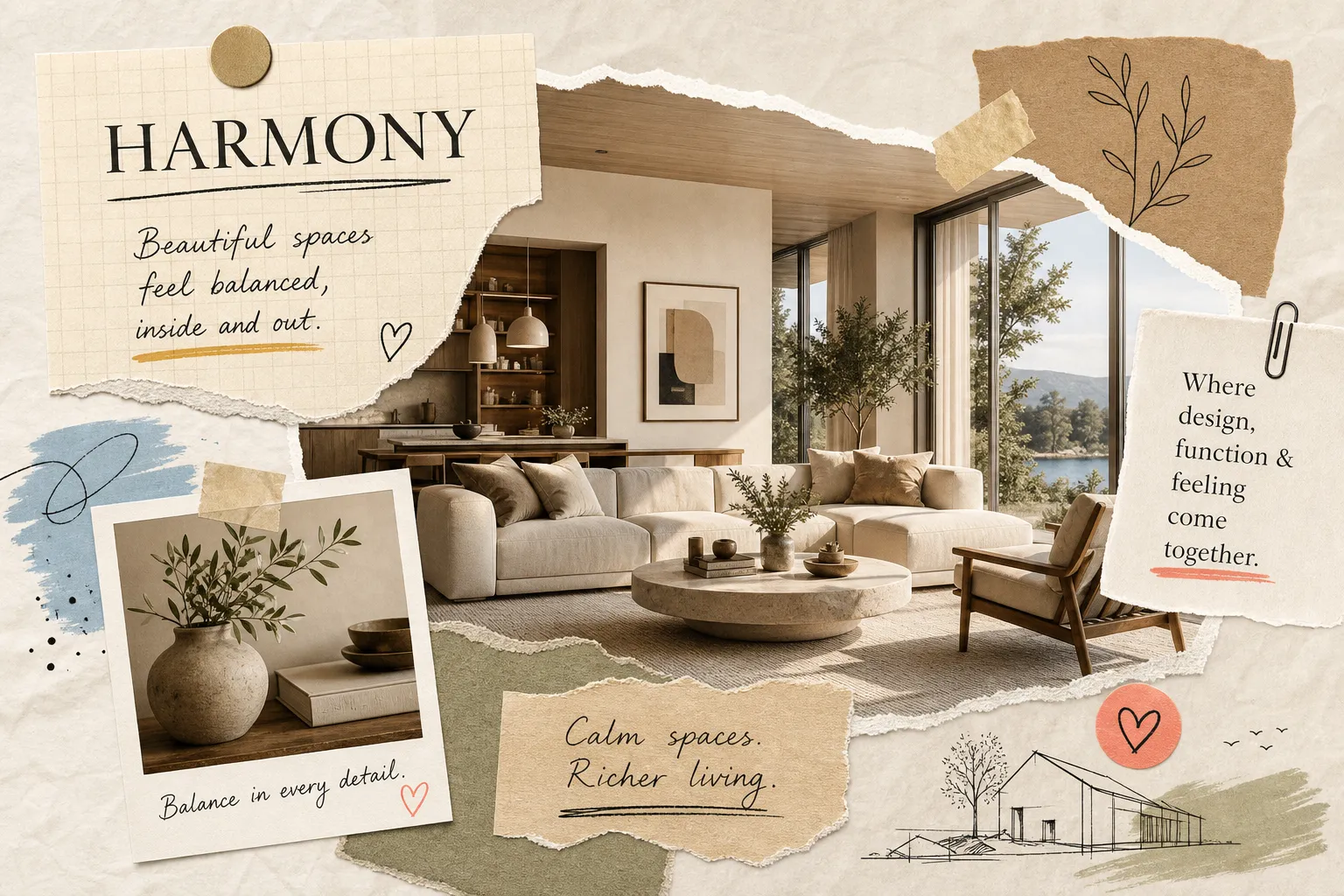
The word “harmony” appears in almost every luxury real estate brochure printed in India. Harmony Homes, Harmony Residences, harmony-inspired interiors: the phrase is so widely used that it has become nearly meaningless. Developers attach it to projects ranging from affordable apartments in Tambaram to premium villas on the Goan coast, trusting that the word carries enough emotional weight to do the selling. It rarely does, because the homes themselves rarely deliver the feeling. Luxury home harmony, the genuine article, is something far more demanding, and far more rare.
Genuine harmony in a luxury home is not a styling choice or a brochure promise. It is a design discipline, one that demands proportion, material, light, landscape, and human experience working together without friction or apology. Every element belongs. Nothing competes. Nothing is missing. When a home achieves this, residents feel it before they can explain it. When a home fails to achieve it, no amount of imported marble or rooftop amenities can compensate. At Keshavaa, we have built our entire design brief around this discipline for nearly two decades. What follows is our honest account of what luxury home harmony actually demands, and how to recognise it.
Most premium apartments and luxury residences use the word harmony to imply pleasant aesthetics: coordinated colour palettes, furniture that matches, finishes that look expensive. What the word genuinely refers to, in architectural and interior design terms, is the condition where every element of a space belongs, where individual decisions about scale, texture, colour, and placement respond to one another rather than to a mood board assembled in isolation. True luxury home harmony is the difference between a space that photographs beautifully and one that is genuinely liveable.
A room can be visually striking and still feel unsettled. You can furnish it with beautiful objects, light it with precision, and photograph it for a design magazine, and yet something in the experience of being in it resists ease. This is because visual beauty and design coherence are not the same thing. Coherence is the condition where the ceiling height relates to the floor area, where the door proportions respond to the wall, where the furniture scale acknowledges the room rather than simply occupying it. A home achieves harmony when its parts are in genuine conversation with each other, not simply arranged within the same four walls.
When a space is harmonious, a resident or visitor perceives it emotionally before they analyse it intellectually. The feeling arrives first: an ease, a sense of arrival, the instinct that you have entered somewhere considered. The ceiling height relates to the floor material. The window placement responds to the landscape beyond. The threshold between one room and the next has been thought about. Most buyers describe this experience as “the home just feels right” without being able to articulate why. That difficulty of articulation is not a failure of language; it is evidence that the design has done its work at a level deeper than the visible.
Luxury home harmony rests on five interconnected pillars: proportion, material, light, landscape, and human experience. These are not independent features to be checked off a list. They are forces that must be calibrated together, because each one affects how the others are perceived.
The relationship between ceiling height, room width, door frame size, and furniture scale determines whether a room feels expansive or merely large. This distinction matters enormously. A room that is physically large but poorly proportioned will feel uncomfortable in a way that no decorator can fully resolve, because the problem is structural. Genuine harmony in a luxury home demands that every dimension is intentional and referential to the others. This is precisely where many volume-driven developers with impressive amenity counts fall short: they maximise square footage without calibrating proportion, producing spaces that look generous on a floor plan and feel hollow in person.
The choice of materials, stone, timber, plaster, metal, and the way natural and artificial light interact with those surfaces creates either tension or calm. Harmony demands restraint: fewer materials used with deeper understanding rather than a catalogue of premium finishes applied for effect. A single species of stone, understood in terms of how it reads in morning light versus evening, how it feels underfoot, and how it ages, will contribute more to a cohesive home than three prestigious materials competing for attention. The discipline of restraint is one of the hardest principles for large-scale developers to follow, because restraint does not photograph as impressively as abundance.
A harmonious luxury home does not merely offer views; it is in genuine dialogue with its natural surroundings. The threshold between indoor and outdoor space and the way a garden or coastline is framed by an opening are both expressions of place-led design. So too is the use of earth-sourced materials that echo the land outside. In Goa, where the natural environment, laterite rock, monsoon light, the Arabian Sea, old-growth canopy, is foundational to the living experience, this dialogue is not optional. It is the design. Homes that ignore it produce a peculiar claustrophobia: you can see the landscape from the window, but you never feel connected to it.
Harmony is rare in the Indian luxury residential market despite being universally claimed. This is not a question of budget. Many luxury residences with impressive amenities lists, high-end finishes, and well-appointed luxury home décor still feel incoherent. The issue is one of design intent and scale. Without a founding commitment to cohesion, even the most expensive components fail to produce a home that holds together.
When a developer’s model depends on selling a large number of units across multiple phases, design decisions become standardised. Floor plans are replicated across floors and wings. Finish palettes are selected for broad appeal rather than a site-specific response. The relationship between each home and its specific position on the land, its orientation, its views, its relationship to neighbouring units, is rarely considered in depth. The result is premium apartments that look expensive but feel generic: spaces that could exist anywhere, because they were not designed for anywhere in particular.
The tendency in large-scale luxury real estate to substitute amenity count for design depth is understandable commercially and damaging architecturally. A rooftop pool, a co-working lounge, a golf simulator: these are additive features. They do not create harmony. They create a brochure. A home achieves genuine cohesion through the quality and intelligence of its foundational decisions, including how the structure sits on the land, how light moves through it across the day, and how the materials age together, not through the length of its luxury apartment amenities list. When buyers choose a home primarily on amenity count, they often discover after possession that they live in a space that is impressive to describe and uncomfortable to inhabit.
At Keshavaa, harmony is not applied to a home after the structure is complete. It is the first line of the design brief. This distinction, simple to state and genuinely difficult to sustain across every decision in a project, is what separates boutique development from the standard model. Most luxury home renovation or redesign efforts attempt to introduce harmony retrospectively; the results rarely match what is possible when cohesion is baked into the founding intent.
Every Keshavaa project begins with the land: its orientation, its light patterns across seasons, its relationship to water, vegetation, and the quality of sky it holds. Before a floor plan is drawn, the site has been observed. Every material selection, spatial decision, and structural choice is then tested against a single question: does this serve the cohesion of the whole? This is the opposite of the standard approach, where harmony is applied cosmetically through décor and styling after the structure is already determined. By that stage, the most important decisions have already been made, and they cannot be undone by a considered choice of cushions.
Handcrafted construction allows for responsiveness at every scale. When a doorway, a window reveal, or a staircase is built by hand and to specification rather than sourced from a standard catalogue, the detail can respond to its context. A door frame can acknowledge the wall it interrupts. A staircase can relate to the ceiling above it. This is the design lever that high-end property developers working at volume cannot access: the ability to make every element of a home feel considered rather than installed. It is also what gives a Keshavaa home its particular quality of quiet attentiveness, the sense that someone thought carefully about every corner.
The practical question, once you understand what luxury home harmony means and how it is achieved, is how to recognise it when you walk through a door. This matters whether you are evaluating a Harmony Homes project in Chennai, a boutique villa in North Goa, or any other luxury residence that claims design coherence.
The instinctive experience of entering a harmonious space is reliable as a diagnostic tool. Notice the quality of light in the entrance: is it considered, or is it an afterthought? Observe the relationship between the floor plane and the ceiling. Ask yourself whether the first view from the entrance has been composed intentionally, or whether it is simply what happened to be there. These early impressions are not superficial responses; they are evidence of whether the design process was guided by a coherent intent or assembled from standard components.
Transitions reveal design integrity more reliably than showpiece rooms. How does one room meet the next? How are materials managed across thresholds, do they continue with intention, or change abruptly without reason? How is a bathroom or utility space treated compared to the main living area? In a truly harmonious luxury home, there are no spaces that feel like afterthoughts. The care applied to the living room is present in the corridor, the laundry, the stairwell. Every corner has been considered, because the designer understood that harmony is a condition of the whole, not a quality applied selectively to the rooms most likely to be photographed.
Whether you are evaluating a Harmony-branded residence, a boutique development in Goa, or any premium apartment in a major Indian city, the following questions will separate genuine design intent from well-crafted marketing language.
Ask the developer to walk you through one design decision that was changed because of the land or the light. Ask what materials are used structurally versus decoratively, and why. Ask how this specific home relates to the natural environment around it. A developer with genuine design intent will answer these questions with specificity, referencing the site, the process, and the trade-offs that were made. A developer relying on marketing language will respond with adjectives: iconic, curated, elevated, world-class. The absence of specificity is the signal.
Practical verification matters as much as design philosophy. Confirm RERA registration and review the project’s registration history, including any extension proceedings, which indicate schedule changes. Visit completed projects rather than show flats: the show flat is styled for photography, while a completed home that has been lived in for two years tells you what the developer actually built. Speak to existing residents if possible. Ask about post-handover support and whether the developer remained engaged after possession. The homes already standing are the most honest account of what a developer believes in. The renders in the brochure are the account they would prefer you to use.
Luxury home harmony is a discipline, not a decoration. It is the result of deliberate decisions made at every stage of design and construction, from the first site survey to the last craftsman’s detail. It cannot be retrofitted through renovation or approximated through a premium finishes budget. It either lives in the founding intent of a project or it does not exist at all.
For a buyer navigating a market full of beautiful-looking residences that ultimately feel hollow, the ability to recognise genuine luxury home harmony is the single most valuable skill to develop. The homes that achieve it are rare. The developers who build them with intention are rarer still. When you find one, the experience of living in that space will confirm everything described here, not in words, but in the quiet, lasting feeling that you are exactly where you are supposed to be.
At Keshavaa, that feeling is the only brief that matters. If you are considering a home in Goa and want to understand what that means in practice, we invite the conversation.