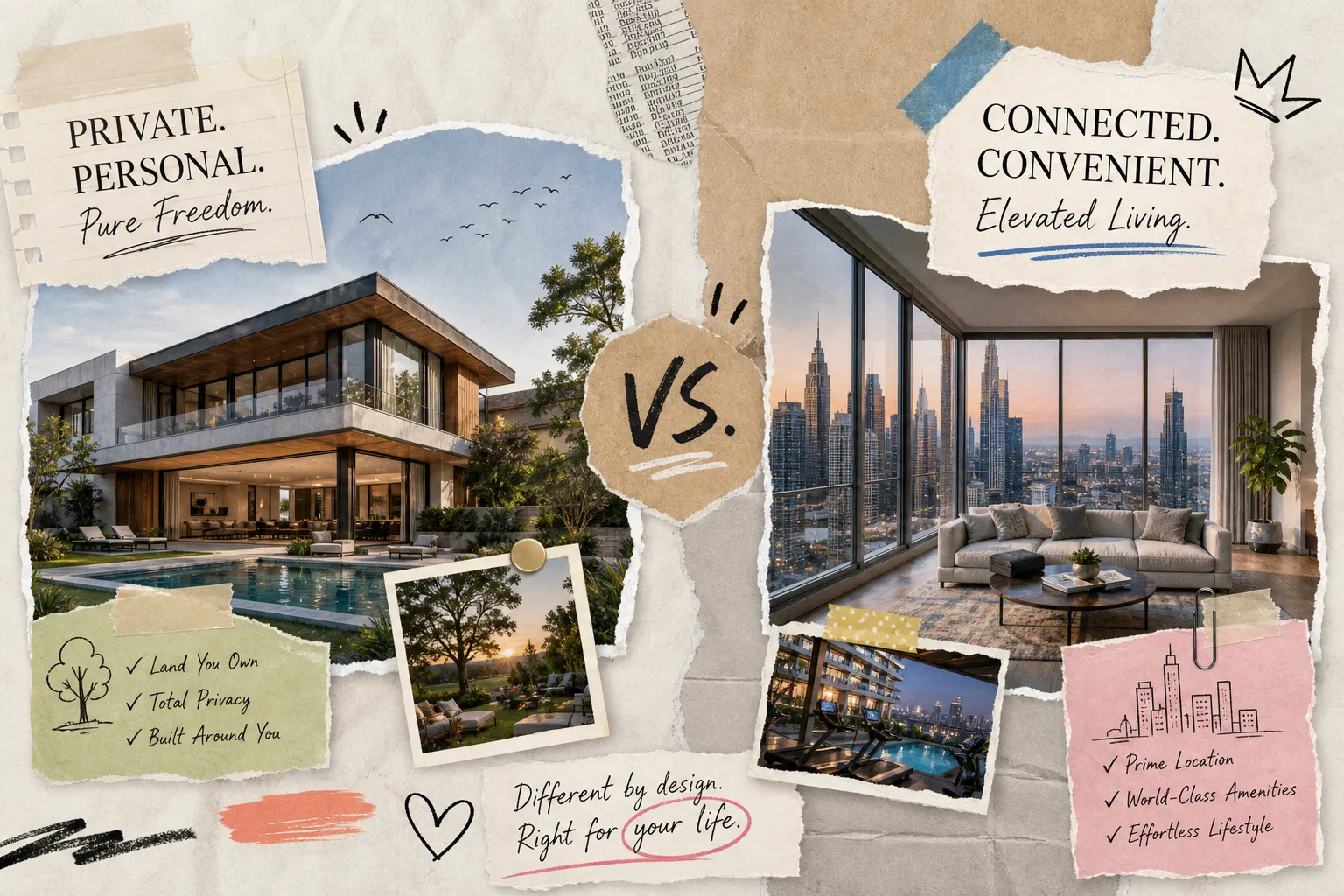
What separates a truly luxury home from a premium apartment is not the brochure, it is the details. The word “luxury” appears on everything now: on ₹1.5 crore flats in suburban townships, on gated communities with shared pools in satellite cities, and on bespoke eight-villa developments on hillsides in Goa. Market observers and property consultants have noted how freely developers apply the label regardless of whether the specification justifies it, to the point where the distinction risks becoming meaningless.
This article draws a clear line. Across design intent, material quality, spatial experience, and long-term value, there are genuine, measurable differences between a truly luxury home and a premium apartment. At Keshavaa, we have spent close to two decades building homes conceived as handcrafted legacies rather than units, and that experience has given us a precise understanding of exactly where that line falls.
Here is the question worth sitting with: if two properties both carry a price tag above three crores, how do you know which one is actually worth it? The answer is not found in a brochure. It is found in the details.
India has no government-mandated definition separating luxury from premium housing. Developers and market analysts use a working combination of price band, location scarcity, unit density, and specification level. Premium housing typically falls between ₹1 crore and ₹3 crore in most metros; luxury starts closer to ₹3 crore and frequently exceeds ₹5 crore in Mumbai or central Delhi, based on price-band frameworks used by research firms such as Anarock and JLL in their annual India residential reports. For readers looking for a comparison of how “luxury” and “affordable” are positioned in India, see decoding luxury vs affordable housing in India.
Price alone, however, is a weak indicator. A ₹4 crore apartment in a 400-unit tower with shared amenities is categorically different from a ₹4 crore home in a twelve-villa boutique development, even if both carry the same label in the marketing material. The number on the sales agreement tells you very little about what you are actually buying.
Prime micro-markets with genuine scarcity value are what reliably separate luxury from premium. Fewer units per floor, controlled access, and a location that cannot be replicated in the next decade are the structural signals that matter most. Premium projects are typically in well-connected suburbs or emerging corridors; luxury homes, including ultra-luxury residences, occupy landmark sites where supply is constrained by geography, regulation, or both. That scarcity directly shapes long-term value and is one of the most objective tests a buyer can apply when comparing two properties that both claim to be luxury.
Premium apartments are typically designed to satisfy a brief: certain bedroom counts, a marble lobby, a clubhouse that photographs well. A truly luxury home is designed around how a person will actually live. That means ceiling heights calculated for spatial drama and natural light, not merely for regulatory clearance. It means rooms that relate to each other and to the outdoors with deliberate intention, so that the architecture serves daily life rather than a sales brochure. The difference is felt the moment you walk in, where a premium apartment layout is efficient, a luxury home layout is considered, shaped by the specific proportions of light, outlook, and movement through the space.
At Keshavaa, the founding philosophy is that each home should be a living work of art rather than a unit to be sold and handed over. Boutique scale is what makes this possible: the orientation of a specific bedroom to catch morning light, the way a corridor opens into a courtyard, materials chosen for how they age rather than how they look in a render. At the volume of larger developers, this quality of decision-making simply is not possible.
The real markers are observable and consistent. Natural stone used in full slabs rather than tiles. Hardwood that is solid rather than veneered. Hand-troweled plaster. Bronze or brass hardware with real weight to it. Bespoke cabinetry with seamless joinery. These are the materials and methods of a home built to last across generations.
Contrast this with the laminates, thin-profile veneers, and mass-produced fittings that dominate premium apartments. Thin veneers are particularly prone to delamination under daily use, and mass-produced hardware tends to show wear within three to five years in a high-use residence. In a truly luxury home, expensive materials appear both where they are visible and where they are not, because the structure beneath them is considered with equal care.
Beyond aesthetics, construction quality has signals that are easy to test on a site visit. Solid-core doors that close with a quiet weight. Wall assemblies that provide genuine acoustic separation between rooms. Zoned HVAC with discreet integration rather than exposed ducts running across ceilings. Ceiling heights that feel proportionate to the room rather than simply tall. Smart-home automation that is embedded into the architecture, not retrofitted as an afterthought. For a technical discussion on integrating building services rather than treating them as an afterthought, see this piece on smart MEP and smart HVAC for future-ready buildings. These MEP and construction standards are characteristic of genuinely luxurious homes, and are less commonly present in premium apartments regardless of how the finishes look on viewing day.
A premium apartment complex serves hundreds of families; a luxury development serves dozens, sometimes fewer. That density gap determines whether your lobby feels like a hotel check-in queue or a private entrance, whether your lift opens into a shared corridor or directly into your home, and whether the garden outside your window is a communal lawn or a private terrace. Low density is an engineered feature of luxury, designed in from the beginning rather than being a side effect of smaller supply.
Luxury homes in India have begun offering services previously associated with five-star hotels. Rather than itemising them for effect, what matters is that these services, dedicated concierge, valet and housekeeping arrangements, round-the-clock maintenance response, private wellness facilities, in-home chef options, and curated resident experiences, function as the texture of daily life rather than a checklist in a brochure. Premium apartments offer a clubhouse and a gym. A truly luxurious home offers a lived experience that does not require you to leave.
Ownership costs differ more than most buyers anticipate. Premium apartments in major metros typically carry maintenance charges of ₹4 to ₹8 per sq ft per month; luxury homes attract ₹8 to ₹15 or more per sq ft because of higher service levels and more intensive upkeep (figures drawn from Anarock and JLL residential cost benchmarks). For a 2,500 sq ft luxury residence, that translates to roughly ₹20,000 to ₹37,500 or more each month.
For context on acquisition pricing: Mumbai’s prime luxury market currently sits between ₹25,000 and ₹1.10 lakh per sq ft, while Bengaluru’s luxury segment runs ₹20,000 to ₹30,000. In Goa’s prime pockets, luxury residential pricing averages around ₹13,290 per sq ft, with high-end listings reaching considerably higher. These figures reflect 2025, 26 market data from published residential research. Recent reporting on the sharp movement in Goa’s market can be found on Business Today.
According to residential market research, the luxury segment’s secondary market has grown at approximately 11.55% CAGR over recent years, and some near-possession developments have seen resale prices rise by up to 40%, figures that Knight Frank and Anarock have documented in their India luxury residential trackers. Premium apartments offer steadier, broader-based rental demand and easier leasing, but luxury homes generate stronger resale upside when scarcity and developer reputation support price discovery. For rental investors, luxury villas in Goa have reported gross yields of 6% to 12% annually, significantly outperforming premium apartments in Bengaluru and Mumbai, which typically yield 2.5% to 4%.
Visit an occupied or near-complete unit, not just the sample flat. Test the door weights and listen for acoustic separation between rooms. Check how services are concealed or exposed, examine how materials meet at joints and corners, and note the ceiling proportions relative to room size. Ask to see a typical lower floor rather than the premium showcase unit. A luxury home should be consistent throughout the development, not only in the spaces designed to impress on viewing day.
These questions are worth raising with any developer you are seriously considering. They are specific and direct, and a developer who builds with genuine intention will address each one without deflecting into marketing language. In fact, the willingness to answer them plainly is itself a quality signal.
A developer who hesitates, deflects, or reverts to brochure language in response to these questions is telling you something important about how they operate. Concrete red flags include an unwillingness to share approved drawings, the absence of clear warranty terms, and the inability to offer references from completed projects.
Understanding what separates a truly luxury home from a premium apartment ultimately comes down to this: the difference does not live on a feature list. It lives in design intent, material honesty, spatial generosity, genuine privacy, and a developer’s long-term relationship with what they build. A high-end finish schedule does not make a home luxurious. Architectural consideration, craft, and an unwillingness to compromise on what matters are what do. For more on our thinking and projects in this space, see our Luxury Real Estate, Keshavaa coverage.
At Keshavaa, the approach has been consistent since 2008: treat every home as something that outlasts the transaction. That means building at a scale where every decision can be made deliberately, and where the person who will eventually live in that home is present in the thinking from the first sketch to the final handover. It is the only way we know how to build.
If you are weighing a property decision and want to understand what this approach looks like in practice, we invite you to explore our current development in Goa. Speak to us directly, if you want genuine clarity on what separates a truly luxury home from a premium apartment, a straightforward conversation is the best place to start.