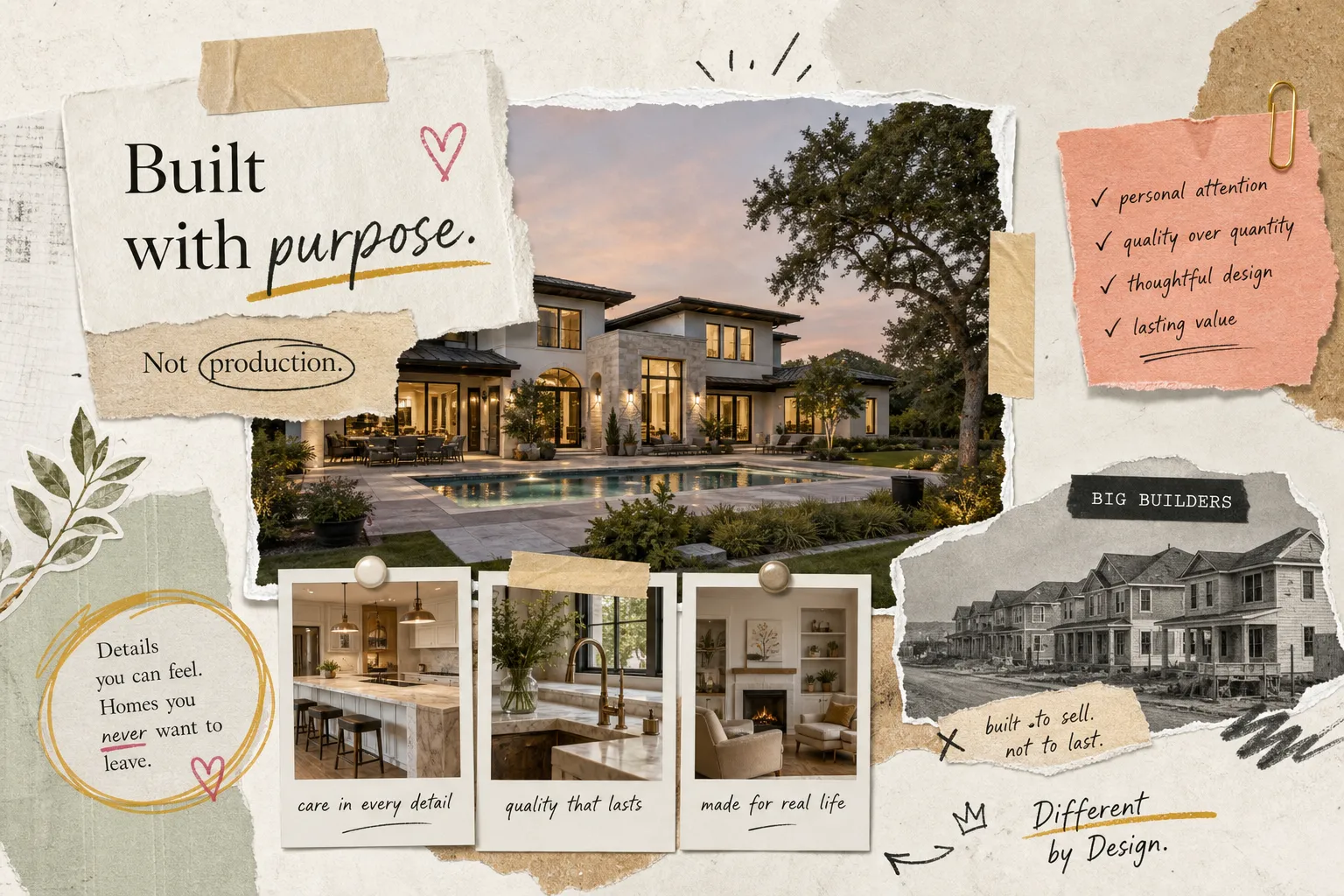
Why boutique developers build better luxury homes than large builders is a question worth examining carefully, because the answer has real financial consequences. The word “luxury” has been stretched so thin by large builders that it now risks meaning almost nothing. Two homes can share the same price tag, the same square footage, and the same brochure vocabulary, yet differ entirely in how they were conceived, built, and what they will be worth a generation from now.
This article makes a direct, evidence-backed case for the boutique builders vs large builders debate, covering material quality, design intent, supervision standards, and the long-term value of a home built to endure rather than to sell. At Keshavaa, a boutique luxury developer rooted in Goa since 2008, this distinction shapes every project: each home is conceived as a handcrafted legacy, not a unit on a delivery schedule. Understanding the difference is worth your time before any serious purchase decision.
Large national builders have mastered the language of luxury without always honouring its substance. Their model is built on economies of scale: standardised floor plans, bulk-purchased materials, repeatable construction processes, and compressed timelines of 12 to 18 months per project. Every design decision filters through cost-per-unit arithmetic, and even premium-tier projects typically offer buyers access to roughly 10 to 20% of a home’s design choices via preset finish packages, the remainder is decided before the buyer is ever involved.
Speed works against craftsmanship in ways that are measurable, not merely subjective. Compressed construction timelines cut into curing and drying periods. Concrete curing and plaster drying require time that a volume schedule rarely accommodates fully, and this shows up in surface finishes and long-term structural performance. Supervision ratios at large builders typically run 1:50 to 1:100, meaning one site engineer oversees dozens of workers simultaneously. At that ratio, detailed daily quality checks become impractical, a structural reality of the model, not a moral failing. Buyers who understand this make better decisions when comparing large-builder projects with genuine bespoke luxury home builders.
The quality difference between boutique luxury homes and large-builder homes is not a matter of taste. It is quantifiable in specifications, tolerances, and material lifespans. Boutique developers source natural stone, Makrana and Jaisalmer marble from India, Carrara and Travertine from Europe, cut to 20 to 30mm thickness for durability. Large builders typically use engineered or composite stone at 12 to 18mm, which is more vulnerable to staining and surface degradation over time. Flooring in boutique homes uses solid teak, oak, or high-grade imported tiles with PEI ratings of 4 to 5 for scratch resistance, while engineered veneer and ceramic tiles from mass domestic manufacturers are the standard alternative at scale.
The difference is not aesthetic preference. It is measurable lifespan: boutique-specified materials typically hold for 50 or more years, while mass-market finishes begin to show age within 20 to 25 years. Structural steel grades matter too. Boutique developers commonly use TMT Grade 550 or 600 steel with strict quality control on cement batching, while standard Grade 415 or 500 TMT is the large-builder norm. Window glazing in boutique homes uses thermally broken aluminium frames with double-glazed units and low-E coatings. Standard large-builder windows often use non-thermally broken frames and basic single-glazed or budget double-glazed units, which can increase HVAC costs by an estimated 20 to 30% over the home’s life, based on energy modelling data for India’s climate conditions. These are not luxury extras; they are the baseline of a home built to perform over decades.
The sharpest difference between boutique and large builders lies in the design process itself, who controls it and how it is run, as much as in the materials chosen. Boutique developers begin with a design brief that accounts for site orientation, cultural context, natural light conditions, and the specific life the buyer wants to live in the space. Every material, finish, lighting fixture, and joinery detail is specified against that brief, and specification discipline, through annotated drawings, finish schedules, and supplier references, ensures the design intent survives from concept through to construction. Drift between vision and execution is the single greatest cause of disappointment in luxury builds, and tight specification is the only defence against it.
Joinery tolerances in boutique builds are measurably tighter: under 1mm, with hand-polished surfaces and invisible seams. Large-builder joinery typically runs at 2 to 5mm tolerance, which is visible to any attentive eye. At a boutique developer, every element is designed for that specific space, cabinetry, ceiling detailing, hardware, lighting systems, and landscape are all site-specific and client-specific. This is what separates bespoke luxury home builders from volume operators working to a preset catalogue. At Keshavaa, this design philosophy is not a service tier; it is the only way the studio works. Each home is treated as a residential atelier project: a space that reflects the particular sensibility of the land, the climate, and the people who will inhabit it for generations.
Boutique homes also embed smart home infrastructure at the structural level, with wired KNX systems, integrated climate control, and security architecture rather than adding Wi-Fi bulbs and simple thermostats as afterthoughts. The distinction matters more over time than at handover, when a buyer realises that retrofitting genuine home automation into a non-integrated structure is expensive and invasive.
Who is watching the work, and how closely, determines the quality of the finished home more than almost any other single factor. Boutique developers maintain supervision ratios of 1:10 to 1:15, with one architect or senior supervisor overseeing a small, specialist team. Daily site visits are standard practice, not an exception. Master artisans are retained for hand-carving, stone inlay, custom metalwork, and specialist installations. They are not retained as decorative flourishes but as the mechanism through which precision is maintained at each stage rather than corrected at the end. Material waste at boutique builds typically averages below 5% because precision cutting and custom fabrication reduce offcuts, while large-builder waste commonly runs at 10 to 15%, a figure that reflects both the speed of installation and the absence of bespoke cutting.
In a boutique development, buyers commonly have direct access to the lead architect and senior decision-maker throughout the process. Questions get answered, changes get considered, and issues get resolved without escalating through layers of customer service. Large builders rely on more formal structures: dedicated sales contacts, warranty departments, and ticketing systems. These structures handle volume efficiently but create distance between the builder and the buyer at the precise moments when accountability matters most. Reputation at a boutique developer is not protected by marketing spend; it is protected by the quality of every home delivered, making trust a genuine commercial asset rather than a brand promise.
The investment case for a boutique luxury home is stronger than its large-builder equivalent across several measurable dimensions: material lifespans, after-sales responsiveness, and appreciation potential. Custom luxury homes with a unique architectural identity and premium material specification tend to appreciate more strongly than semi-custom large-builder homes in comparable Indian markets, a directional advantage driven by irreplicability. A home that cannot be replicated holds value differently than one drawn from a repeat floor plan, and boutique development, by definition, produces homes that do not exist elsewhere. Precise appreciation differentials vary by location and project, and India-wide data comparing boutique vs large-builder performance across all markets remains limited, but the structural logic of scarcity and specification quality is well established in premium real estate.
Buyer experience consistently points to boutique builders offering greater responsiveness and direct accountability after handover. When an issue arises in year two or year five, the senior people who built the home are reachable and invested in resolution. Large builders handle higher volumes of warranty claims through structured processes, which works for straightforward issues but creates friction for anything non-standard or requiring a design-level decision. The difference lies not in whether issues arise but in how they are resolved and by whom.
A boutique home built with intention, precision, and materials specified for longevity becomes an asset in the truest sense: something that holds, grows, and passes well to the next generation. This is how Keshavaa has worked since its founding in Goa in 2008, every project treated as a long-term proposition, not a transaction, and each home as a living work of craft that should grow in value and meaning rather than depreciate into a dated floor plan.
Knowing why boutique developers build better luxury homes than large builders is only useful if a buyer can identify and evaluate a credible one before signing. The brochure is rarely where the truth lives; the questions you ask in a direct conversation are where the real evaluation begins.
Watch for these red flags: finish packages with limited options disguised as curated selections; supervision described as “regular” without specific ratios or frequency commitments; and timelines that seem optimistic for the level of customisation being promised. Genuine boutique builds typically take 18 to 36 months depending on project scope, and that timeline exists for good reason. Any developer promising bespoke craftsmanship on a production schedule is describing something that does not add up.
Large builders serve a purpose: they deliver volume, speed, and predictability. But luxury, properly understood, is not a category compatible with those priorities. A home designed with intention, built under close supervision, and specified with materials that last 50 years is a different proposition entirely from one produced on a volume schedule, and that difference compounds over decades of ownership.
That structural distinction is the entire basis of how Keshavaa works. Rooted in Goa, with nearly two decades of boutique development behind it, the studio has built its reputation on a process that treats every custom home as the only one of its kind. If you are evaluating a luxury property purchase in India and want to understand what that philosophy looks like in practice, the questions in this article are where the conversation begins.