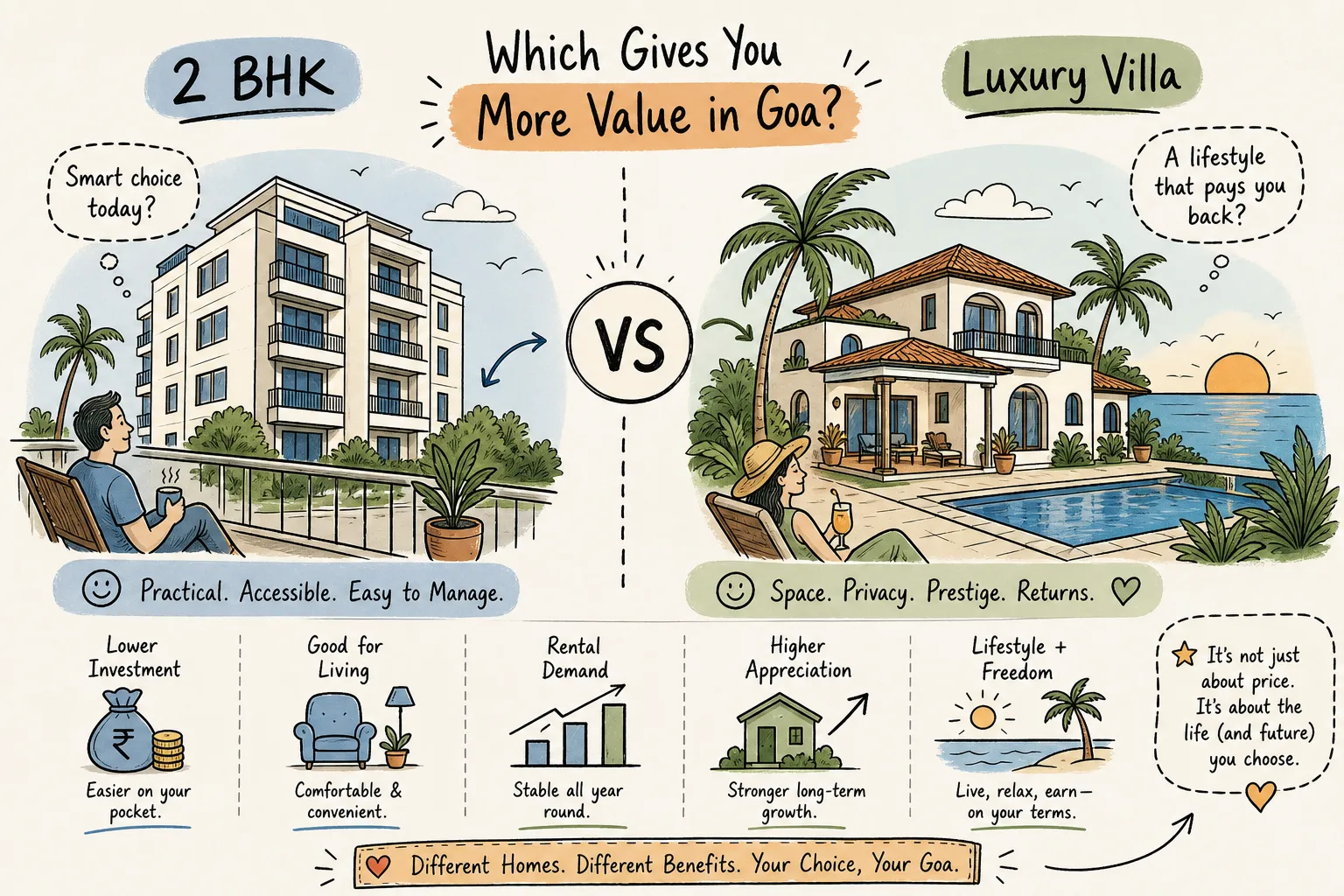
A two-bedroom apartment in Goa looks, on paper, like the sensible entry point into one of India’s most coveted property markets. It is accessible, manageable, and feels like a logical first move. But sensible and valuable are not always the same thing, and in Goa’s property market, the gap between the two can be significant. For anyone weighing a 2 BHK in Goa against a boutique villa, the decision goes beyond floor area.
Both categories attract serious buyers in 2026, each with a distinct investment logic. Apartment buyers are often drawn by lower capital entry, faster liquidity, and the reassurance of a familiar asset class. Villa buyers are thinking about a different horizon entirely: design, land ownership, rental premium, and long-term worth. This article compares both on the metrics that matter: price, rental income, resale potential, maintenance costs, and lived experience, so that buyers can make an informed decision before committing to either.
The first thing to understand about 2 BHK flats in Goa is how wide the price range truly is. A two-bedroom apartment in Margao starts around ₹45 lakh, while the same configuration in Calangute can exceed ₹2.5 crore. Mapusa sits in the ₹50 lakh to ₹1.1 crore band, Panaji runs from ₹65 lakh to ₹1.5 crore, and Porvorim, Goa’s most active mid-market corridor, clusters between ₹1 crore and ₹2.2 crore. North Goa as a whole averages approximately ₹15,492 per sq ft for 2 BHK price per sq ft, but beach-belt units command a significant premium over anything inland.
These are asking-price ranges, not transaction averages, and the variance within a single locality is often as striking as the variance between localities. A 2 BHK near the Calangute beachfront is a fundamentally different asset from a 2 BHK three kilometres inland, even if both carry a North Goa address. Not all two-bedroom apartments in Goa are created equal, and the price alone rarely tells the full story. Buyers exploring 2 BHK for sale in Goa should treat locality as the primary filter, well ahead of configuration or quoted price per sq ft.
Boutique luxury villas in North Goa are typically listed from around ₹5 crore, with premium properties reaching ₹11 crore and above depending on land size, architectural design, and finish quality. The premium reflects something real: land ownership rather than a share in a building, purposeful architectural design, exclusivity, and a fundamentally different asset class. The price gap between a 2 BHK flat and a boutique villa is real, but so is the difference in what each buyer is actually acquiring.
Calangute, Baga, and Candolim remain the strongest short-stay corridors for two-bedroom apartments. Long-term rental listings in Calangute range from approximately ₹35,000 to ₹85,000 per month, depending on furnishing standard and proximity to the beach. Short-stay demand across these corridors is well established, with guest traffic concentrated in the December-to-March peak season. Occupancy is seasonal, however, and heavily dependent on platform visibility, property presentation, and competitive pricing against an expanding supply of similar listings.
Gross rental yield for a well-located 2 BHK in Goa’s beach belt sits in the 5 to 6 percent range on long-term leases, and can reach 8 to 12 percent on short-stay if managed professionally and positioned well. After platform fees, management costs, furnishing upkeep, and periods of vacancy, net yield is meaningfully lower than the headline figure. Buyers who build their investment case on gross yield alone tend to be surprised by the reality of net returns. If you’re specifically weighing short-stay strategies, consider reading our detailed take on buying a second property in Goa for Airbnb to understand the trade-offs between occupancy, furnishing costs, and long-term appreciation.
Boutique luxury villas operate in a different rental economy. Based on sampled listings across professional management platforms, peak-season nightly rates for well-positioned North Goa villas are broadly estimated in the range of ₹15,000 to ₹40,000, and the guest profile is a discerning traveller who books longer stays and expects a curated experience rather than a standard holiday flat. Peak-season occupancy for professionally managed luxury villas in North Goa is broadly estimated at 55 to 65 percent, with off-season at 25 to 35 percent, with these estimates corroborated by short-term rental datasets such as Airbnb data for North Goa. Even at that occupancy, the absolute rental income and calibre of guest often justify the higher acquisition cost. Yield for a boutique villa is a function of positioning and quality, not just location. A well-designed villa in the right village outperforms a generic apartment on the same road.
Resale liquidity for 2 BHK apartments is reasonable in well-established North Goa corridors. Porvorim and Calangute offer the strongest combination of buyer demand and resale activity within the apartment segment. Properties in good condition, from reputable builders, in well-run complexes, tend to move without prolonged market exposure. That said, 2 BHK resale value in generic apartment blocks typically tracks the broader market rather than outperforming it. Builder reputation, project age, and building maintenance standards all constrain how much a standard apartment can appreciate beyond the market average.
Competition from new launches adds further pressure. North Goa’s pipeline of new residential projects is active, and buyers looking in the resale market always have the option of a freshly launched apartment at a comparable price. That dynamic limits how aggressively sellers can price older stock, particularly in corridors with high supply. For broader context on where Goa prices are heading, see recent property price trends in Goa for 2025, 2026, which highlight pockets of relative strength and the corridors where appreciation has been concentrated.
Boutique luxury villas carry a different appreciation curve, rooted in scarcity. There is a finite supply of well-designed, land-owning boutique properties in North Goa’s premium villages, and that supply is not being replicated at scale. Buyers in this segment are not choosing between dozens of identical units; they are choosing between a handful of properties that are genuinely irreplaceable. Long-term capital appreciation for boutique luxury homes in Goa is widely attributed to rising land values and growing international appetite for curated Goan experiences, a hypothesis supported by the trajectory of premium village transactions over the past decade, though hard comparative data remains limited to private broker records. That combination does not diminish with age. It deepens.
Society maintenance for a 2 BHK apartment in a managed residential complex in Goa typically runs between ₹2,500 and ₹5,500 per month, with premium complexes exceeding ₹10,000 per month where facilities are extensive. Add sinking fund contributions, parking levies, and the occasional special levy for building repairs, and annual ownership costs can accumulate to ₹50,000 to ₹1 lakh before a single maintenance call is made. Buyers who calculate their net yield without accounting for these costs consistently overestimate their actual returns. For a practical primer on recurring charges and how they are governed, refer to the overview of apartment maintenance charges rules and regulations.
Furnished apartments used for short-stay rental carry additional upkeep: soft furnishings, appliance replacement, deep cleaning between guests, and common-area costs. These are not extraordinary expenses, but they are regular, and they tend to be underestimated at the acquisition stage. The maths changes materially once they are factored in.
Villa ownership involves higher absolute costs: grounds maintenance, pool servicing, and a caretaker if the owner is not resident. But these costs are entirely within the owner’s control. There are no shared-society decisions, no majority votes on building upgrades, and no dilution of the property’s identity by a committee. Well-built villas, constructed to a high standard of material quality, also require less reactive maintenance than older apartment stock. Durable construction is, in the long run, more economical than deferred repairs in a building managed by consensus.
A 2 BHK flat in Goa, particularly in a well-run complex near the beach, offers convenience, security, and a low-maintenance entry into Goan living. For buyers whose primary goal is a foothold in the market or a rental-generating holiday home, it is a perfectly rational choice. The property is easy to lock up and leave, easy to list on rental platforms, and familiar in format for buyers accustomed to apartment living in Indian metros.
The trade-off is that the experience is largely indistinguishable from apartment living anywhere else: shared corridors, uniform layouts, a builder’s interpretation of what “luxury” looks like. These are not failings, but they are limitations. Many buyers and resident agents note that a standard apartment complex does not feel like Goa in any particular way; it feels like a well-appointed flat that happens to be in Goa.
A boutique luxury home, by contrast, is designed around its site: the light, the land, the prevailing breeze, the surrounding landscape. It does not try to replicate city living in a coastal setting. Keshavaa builds precisely in this tradition. Each residence is rooted in Goan vernacular architecture, uses natural materials sourced to suit the climate, and is oriented to belong to its surroundings rather than sit on top of them. The lived experience is quieter, more personal, and far more difficult to replicate. That irreplicability is not incidental; it is the whole point, and you can read more about why gated villas are dominating Goa’s luxury market as a parallel trend shaping premium demand.
A two-bedroom apartment in Goa is the right choice under specific conditions. If your budget is firmly under ₹1.5 crore, if you want relatively immediate rental liquidity, or if you are testing the Goa market for the first time, a well-located apartment is a sensible starting point. Within the segment, Calangute and Porvorim offer the strongest combination of rental demand and resale potential. Locality matters more than configuration; a 2 BHK in the right pocket will always outperform a 2 BHK in the wrong one.
The boutique villa argument becomes significantly stronger if your investment horizon extends to seven to ten years, if design and lived experience matter to you, or if you are building a legacy asset rather than simply adding a rental unit to your portfolio. Stamp duty in Goa is levied on a slab basis (broadly 3.5 to 5 percent depending on property value), with registration charges of approximately 3 to 3.5 percent on top, buyers are advised to confirm the current schedule directly with the local sub-registrar, as published summaries vary. For a clear, up-to-date explainer on stamp duty and registration charges, consult comprehensive guides such as the one from Godrej Capital. These transaction costs favour a buy-and-hold approach regardless of asset type, but they particularly favour assets that appreciate meaningfully over time.
Buyers who arrive at the boutique villa conclusion will want a developer with a clear track record in Goa: a transparent process, a design philosophy rooted in the local vernacular, and a demonstrated history of delivering homes that hold their value. Buying a Villa in Goa is a different proposition with its own risk-return profile and operational considerations. Keshavaa was built for precisely this kind of buyer. The question is never really apartment versus villa. It is what kind of asset, and what kind of life, you are actually trying to build.
Both options have genuine merit, but they serve fundamentally different buyer goals. A two-bedroom apartment in Goa is an entry point: accessible, liquid, and straightforward. A boutique villa is a statement of long-term intent, backed by scarcity, design quality, and a different category of appreciation.
Those who prioritise rental yield in isolation may find the apartment adequate. For buyers thinking about resale value, lifestyle quality, and generational worth, the numbers consistently favour a different kind of investment. The arithmetic is not complicated once all the costs are on the table.
Goa’s property market is maturing, and the properties that will hold their value through that maturation are the ones built to stand apart, not to blend in. If you are ready to explore what a boutique luxury home in Goa actually looks like, Keshavaa is a good place to begin that conversation.
Prices vary considerably by location. In North Goa’s beach belt, a 2 BHK typically ranges from ₹1 crore to ₹2.5 crore or above, with Calangute and Porvorim among the most active corridors. Mid-market areas such as Mapusa and Panaji offer options from ₹50 lakh to ₹1.5 crore. The 2 BHK price per sq ft in North Goa averages around ₹15,492, though beachfront units command a notable premium.
A well-located 2 BHK in Goa can generate gross yields of 5 to 12 percent depending on whether it is managed as a long-term rental or a short-stay property. Net yield after costs is meaningfully lower. The December-to-March season drives the bulk of short-stay demand, and professional management is essential for consistent occupancy.
Apartment resale in established corridors such as Porvorim and Calangute is reasonably liquid, though appreciation broadly tracks the market. Boutique villas, by contrast, benefit from scarcity and land value, which tend to support stronger long-term capital growth. Buyers with a seven-to-ten-year horizon typically find the villa case more compelling on resale metrics.