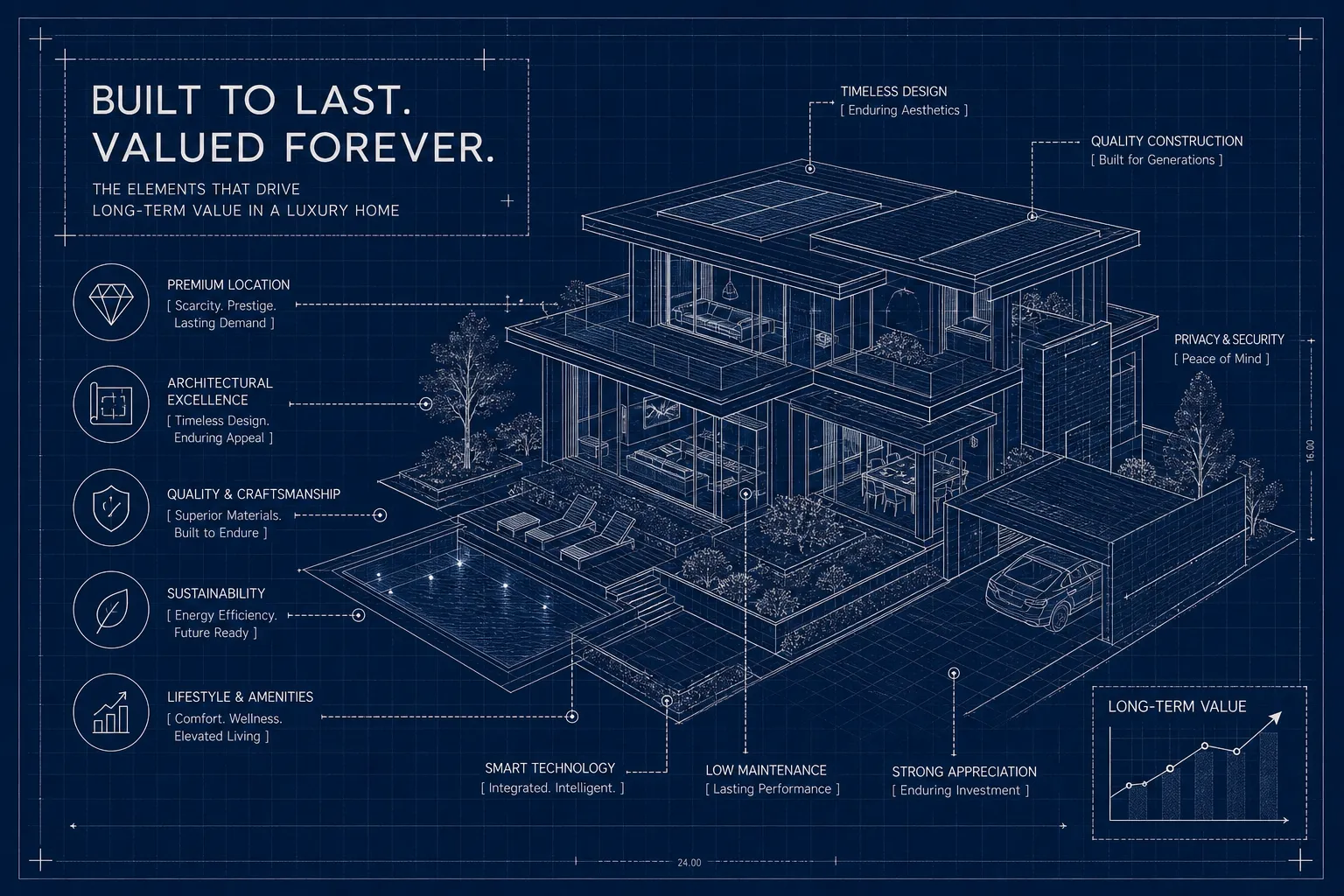
Luxury pricing does not guarantee long-term value. Across India’s prime residential markets, some homes priced above ₹10 crore have quietly stagnated while others in the same city, sometimes in the same postcode, have compounded steadily for a decade. Understanding luxury home long-term value starts with recognising that the difference rarely comes down to luck or timing. It comes down to four factors that are knowable before you sign anything.
At Keshavaa, we have been building in Goa’s prime coastal belt since 2008. Nearly two decades of development, resale observation, and HNI advisory work have sharpened a clear picture of what separates a home that appreciates from one that merely costs a great deal. The patterns are consistent. They point to the quality of the land, the integrity of the construction, the durability of the design, and the reputation of the developer behind the project.
This article works through each factor with data and practical clarity, and closes with a lens you can apply to any luxury home you are evaluating in 2026.
City-level market data tells you surprisingly little about a specific home’s appreciation potential. Two luxury properties in the same metro can diverge meaningfully in annual appreciation, driven entirely by micro-location. The question is not whether Mumbai or Bengaluru is a good luxury market. The question is whether the specific pocket of land your home sits on has the structural qualities that protect and grow its value over time. Recent coverage of the top Indian cities seeing the largest price rises helps illustrate how city-level trends can mask micro-location differences.
The most durable appreciation factor is supply constraint. Natural barriers, coastal land, heritage zone designations, or forest buffers, act as value floors because they prevent the overdevelopment that erodes scarcity. North Goa’s coastal belt illustrates this well: strict Coastal Regulation Zone rules and a finite stock of developable land mean that well-positioned homes here face structurally low risk of supply flooding. Those constraints are regulatory and geographic in nature, not cyclical, and their effect compounds over decades rather than years.
Infrastructure repricing is the second lever. Connectivity improvements, new airports, expressways, and metro extensions, have accelerated luxury absorption in corridors like Gurugram and Bengaluru’s technology precincts, as documented in successive JLL and Anarock residential market reports. When infrastructure improves access to a prime location, demand broadens without supply expanding to match it. The result is a repricing that benefits early holders disproportionately.
Destination markets add a third dimension that pure residential metros cannot replicate. Goa’s steady inflow of HNI buyers and NRI second-home demand broadens the effective buyer pool well beyond local end-users. When you eventually sell, your buyers include the same affluent domestic and overseas purchasers who characterise the wider market, a dynamic that supports both resale speed and pricing power, as NRI and HNI transaction volumes in North Goa have grown consistently over the past several years. If you’re considering owning a second property in Goa to capture both appreciation and short-term rental demand, our analysis on buying a second property in Goa for Airbnb explores that trade-off in depth.
Luxury home resale value is inseparably tied to how the home was built. A home with poor structural integrity, generic floor planning, and low-grade finishes carries a hidden cost that erodes both rental yield and eventual resale pricing. The marketing brochure does not hold its value. The construction does.
The carrying cost penalty is real and measurable. Luxury villa owners in India can expect ongoing costs of 4 to 6 per cent of property value per year, covering maintenance, society charges, property tax, insurance, and staffing. Poorly built homes with ageing fittings, failing imported finishes, or recurring structural issues push that ceiling higher. Repairs and upkeep alone can run 1 to 1.5 per cent per year in mass-built luxury developments, a figure that compounds painfully over fifteen years of ownership. For a practical breakdown of these expenses, see a concise primer on the real cost of property ownership.
Homes built with regionally appropriate, earth-sourced materials, proper thermal mass, and genuine artisanal detailing tend to follow a more favourable maintenance curve, based on practitioner observation across completed boutique projects. The materials age with character rather than against the clock. The structural logic is sound from day one rather than being masked by surface finishes. As a result, such homes typically require less frequent intervention, cost less to hold in condition, and present more compellingly at resale than those that have been continuously patched.
Knight Frank’s prime market research confirms that affluent buyers strongly prefer turnkey, move-in-ready homes, and that condition at time of sale is directly correlated with both absorption speed and pricing achieved. A home that looks and functions as intended fifteen years after completion commands a meaningful premium over one that signals deferred maintenance from the moment a prospective buyer walks through the door.
Trend-driven luxury ages the fastest. Homes designed around a moment, maximalist interiors, novelty facades, or amenity checklists built around what was fashionable a decade ago, require expensive repositioning at resale. That repositioning usually comes at a discount, because the next buyer is paying to undo someone else’s decisions rather than inheriting something enduring.
Timeless luxury design is not the absence of ambition. It is proportion over ornamentation, natural materials that develop character with age, and spatial planning that reflects how people actually live rather than how a show flat is staged. The Goan vernacular architectural tradition draws from centuries of climate-conscious, culturally grounded building: high ceilings that manage tropical heat, deep verandas that mediate between interior and landscape, locally sourced laterite and timber that carry the grain of the place itself. None of this requires reinvention every decade. It was never fashionable in the way that fashion works, it was always functional and always beautiful for precisely the same reasons.
The growing buyer interest in biophilic design reinforces this from a market perspective. Homes that integrate natural light, cross-ventilation, landscaped privacy, and a genuine visual connection to their surroundings are consistently favoured at resale in the luxury segment, a preference documented in buyer surveys and reflected in transaction premiums across prime Indian markets. This is not a passing trend. It is a return to first principles that buyers have always valued, and that the market has consistently been willing to pay for when the execution is genuine rather than decorative.
When two comparable homes in the same location go to market, the one built by a developer with a verified track record sells faster and achieves a higher price. Market data from India’s luxury segment, including figures cited in JLL’s India luxury residential research, shows that branded residences from credible developers have demonstrated appreciation rates of 18 to 35 per cent over three-year periods, while Knight Frank’s prime market notes identify developer brand credibility and turnkey finish as the two factors most correlated with faster absorption in prime Indian markets.
Reputation is shorthand for a set of assurances that the next buyer is quietly pricing in: structural quality, on-time delivery history, transparent dealings, RERA compliance, and the confidence that the home will remain desirable to whoever comes after them. A boutique developer with a multi-decade portfolio of completed and well-maintained homes can provide these assurances with a specificity that large-volume developers, managing hundreds of units in simultaneous delivery, find structurally harder to sustain. The accountability model is simply different at scale.
The boutique developer advantage is specific. Personalised advisory, real material and design control, and accountability to a small number of buyers rather than thousands create a fundamentally different development process. At Keshavaa, each project reflects nearly two decades of building in Goa’s prime coastal belt under third-generation founder expertise. That provenance is grounded in a portfolio of completed homes, verifiable through RERA records, site visits, and direct resale history, and it is precisely the kind of evidence that gives the next buyer confidence in what they are inheriting. For context on recent demand patterns among investors in Goa, our review of South Goa villa investment trends explains why a subset of buyers are selectively active today.
To understand the broader market context for branded luxury projects in India, see an industry overview of the India luxury residential real estate market, which highlights drivers shaping developer performance and buyer preferences.
Long-term value is about more than appreciation alone. The net return on a luxury home depends on what it costs to hold and what it earns while you hold it. Both numbers vary considerably between a well-chosen boutique property and a generic luxury development, and the difference is large enough to determine whether the overall investment thesis holds.
Luxury villas in India typically yield 2 to 3 per cent in rental income under conventional long-term tenancy arrangements. Well-positioned luxury apartments in cities like Bengaluru and Hyderabad can reach 3.5 to 4.5 per cent in stronger rental corridors, if you are benchmarking expected income, resources that map where to find the highest rental yields in India can be useful. Against carrying costs of 3 to 6 per cent per year, the net income position is thin. The investment case depends on appreciation compensating for that gap, which it has, historically, in supply-constrained prime locations where demand structurally outpaces new supply.
That arithmetic shifts materially in Goa’s boutique villa market, which operates under a different rental logic. A design-led, architecturally distinctive villa in a prime North Goa location, offered through short-term platforms catering to high-end travellers, is a fundamentally different product from a generic luxury apartment on an annual lease. Market data on North Goa boutique villas, drawn from Anarock’s holiday home research and corroborated by short-term rental platform data, points to yields in the 6 to 10 per cent range, with well-positioned premium properties reaching 8 to 12 per cent when amenity quality and design character support strong average daily rates, subject to seasonal occupancy variation. The effective yield, when combined with the appreciation trajectory of supply-constrained coastal land, produces an investment profile that generic luxury inventory in most metros finds difficult to match. If you are weighing whether the upfront premium for a Goan villa is justified by these returns, our analysis on buying a villa in Goa: is the investment amount worth it? provides a focused financial framework.
After working through the four pillars, the practical question is how to apply them to a specific property you are considering. Luxury home long-term value is not abstract. It is the cumulative result of decisions that are fully assessable before you sign.
Four questions do the work:
Select prime Goa boutique developments sit at the convergence of all four answers. The coastal location is supply-constrained by regulation and geography. The construction, when built with the philosophy Keshavaa has maintained since 2008, draws on vernacular materials and artisanal methods that hold up structurally and aesthetically better than mass-built alternatives over comparable timeframes. The design language is rooted in a centuries-old architectural tradition that does not require reinvention. And the developer’s reputation rests on a small number of carefully built homes with a verifiable history of holding character and value. Available transaction data from select North Goa micro-markets suggests this segment has outperformed generic luxury inventory in value retention in recent years, a trend supported by supply dynamics, buyer composition, and rental yield differentials.
Luxury home long-term value is not a function of price point or postcode alone. It is determined by the quality of the land, the integrity of the construction, the durability of the design, and the track record of the person who built it. Each factor is knowable before you commit. The decision is far more analytical than most buyers have been led to believe.
For buyers evaluating the Indian luxury market in 2026, the strongest returns have come from homes that score well across all four dimensions. In Goa’s prime coastal belt, where supply is finite, design heritage is deep, and boutique developers have built carefully for decades, those homes continue to be built. The question is whether you identify them early enough to benefit from what they reliably do over time.
If you are at the stage of evaluating a specific acquisition, or simply want to understand what Keshavaa has built and where, explore our completed projects or request a property consultation. The conversation starts with the property and the philosophy behind it. Both are worth understanding before you commit.