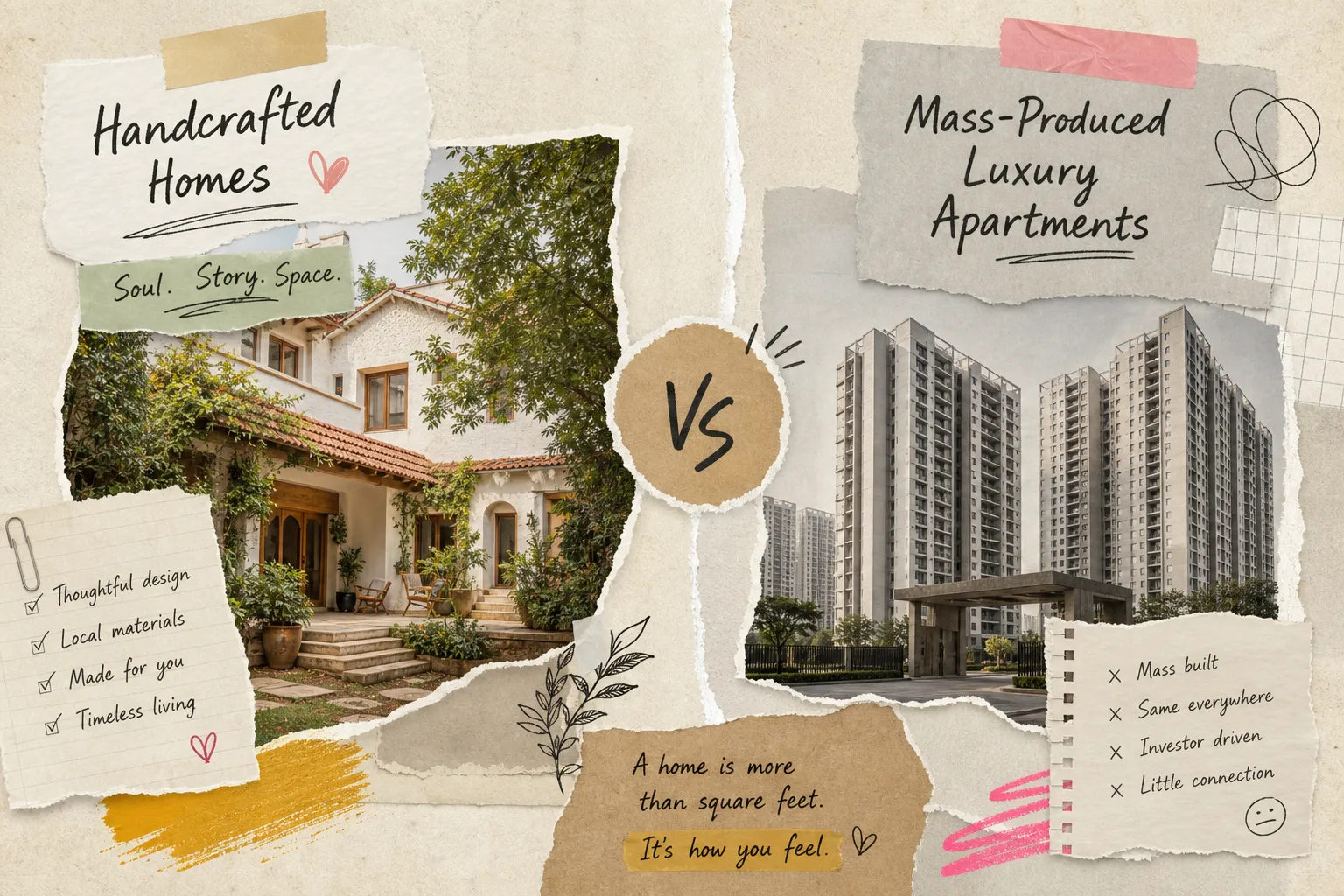
Handcrafted boutique homes versus mass-produced luxury apartments in India, this is the question that defines the upper end of the country’s residential market right now. From glass-and-steel branded towers in Bandra and Whitefield to low-rise boutique residences tucked into Goa’s laterite landscape, the luxury segment has expanded in every direction. But more choice has not brought more clarity. When you are comparing a handcrafted boutique home against a well-specified luxury apartment, are you choosing between two similar products at different price points, or two fundamentally different philosophies of what a home should be?
This is precisely what discerning buyers bring to developers like Keshavaa every season. Is a home built by artisans, conceived around a specific site and a specific life, actually worth what it asks? Or does a branded luxury apartment in a sought-after address deliver equal value with far less complication? The answer depends entirely on what you want your home to do for you. This article works through the comparison honestly, construction quality, pricing, customisation, maintenance, lived experience, and resale performance, so that by the end, you know which model serves your priorities.
Construction methodology is not a behind-the-scenes technicality. It is the foundation on which everything else rests, finish quality, durability, and long-term resale character. This is where handcrafted boutique homes and mass-produced luxury apartments diverge most fundamentally, and where the word “luxury” becomes genuinely complicated.
In an artisan-built home, the process is slower by design. Trades are selected for skill rather than speed. Detail work, the profile of a stone window surround, the jointing in a hardwood floor, the curve of a hand-plastered wall, cannot be templated and replicated across 200 units. It is done once, with full attention, for this particular house. Mass-produced luxury apartments are built for consistency and delivery velocity. “Luxury” in that context refers to the specification tier: the quality of the fittings, the ceiling height, the lobby material board. The construction methodology itself is production-line, designed to deliver a reliable product at scale.
Material sourcing reveals intent most clearly. Boutique developers, particularly those working within a specific cultural and geographic context, source materials with provenance in mind: natural stone from regional quarries, hardwoods chosen for grain and longevity, earth-sourced finishes that respond to the local climate, surfaces hand-finished rather than machine-applied. Large developer supply chains use solid, approved materials chosen for consistency and procurement volume. Neither approach is dishonest. But the difference shows most clearly not in how a home photographs at handover, but in how it ages and how it feels underfoot after ten years.
Bespoke residences are also conceived as architectural statements. The site, the light, the owner’s daily patterns, and the surrounding landscape all inform every design decision from the outset. Standard luxury apartments work from master plans adapted for a target buyer profile, with upgrade packages offered as the primary form of personalisation. One model is shaped by a life; the other by a production brief.
Price per square foot is a starting point, not a verdict. In Mumbai, boutique luxury homes typically range from ₹25,000 to ₹1,10,000 per sq ft. Branded luxury apartments run from approximately ₹40,000 to ₹1,50,000 and above. In Delhi-NCR, boutique homes in central and southern Delhi sit around ₹15,000 to ₹65,000 per sq ft, while Bengaluru ranges from ₹20,000 to ₹30,000 for boutique homes against ₹18,000 to ₹40,000 and above for branded luxury.
The critical insight: in several markets, a carefully crafted boutique home is priced comparably to, or below, a branded luxury apartment on a per-square-foot basis, yet delivers considerably more in terms of individuality, spatial planning, and finish quality. Ticket sizes for boutique homes typically range from ₹5 crore to ₹30 crore depending on location, scope, and the depth of artisan input.
The finish comparison is where the two models make their real argument. Boutique homes offer custom ceilings, handcrafted cabinetry, natural stone surfaces, considered lighting design, and curated outdoor spaces where every element is specifically chosen. Branded residences and premium apartments in India counter with rooftop pools, fitness centres, concierge services, and polished common areas: shared amenity packages that serve the collective experience rather than the individual home. The relevant question is whether you want a home built around your life, or access to a shared infrastructure built around a general idea of luxury living.
Customisation means something different in each context. In a boutique home, it means structural dialogue with the architect from the outset: floor plans, room proportions, ceiling heights, the relationship between interior and exterior. In a luxury apartment, it typically means selecting from a finish upgrade package within a fixed plan. Both are legitimate offerings. They are simply not the same thing.
Move from the specification sheet to the sensory reality of living in each property type, and the differences become visceral. Boutique homes are inherently low-density: fewer units, fewer neighbours, private entries, and dedicated outdoor spaces that belong to the home rather than the building. Large luxury apartment complexes, even the finest ones, are high-density by design. Lifts, lobbies, and corridors are shared. So is the ambient energy of the building, its rhythms, its noise patterns, its daily texture.
For buyers for whom privacy is a primary motivation, and Knight Frank’s Wealth Report data consistently identifies it as the defining driver among HNI boutique purchasers, density is not a minor inconvenience. It is the core issue. A custom-built home in India is quiet in a way that a thirty-storey tower, however well-insulated, cannot replicate. That quiet is not merely acoustic. It is the quality of a space made for you specifically, rather than for a building that happens to contain you.
The two buyer profiles are genuinely different. Boutique home buyers tend to be HNIs and NRIs aged 40 to 65, often purchasing a second home or lifestyle asset, motivated by exclusivity, craftsmanship, cultural depth, and a home that reflects considered taste rather than brand association. Luxury apartment buyers span a broader luxury audience: senior executives, aspirational buyers, and investors motivated by location prestige, shared amenities, and demonstrable status. Neither profile is wrong. They represent different relationships with home, and different answers to the question of what a home is for.
This is the section most buyers under-research, and the one that often produces the sharpest post-purchase surprises. Large luxury complexes spread their fixed costs across hundreds of units. Those costs include security, landscaping, lift maintenance, pool operations, and building administration, which keeps per-flat monthly charges relatively contained. In India, large luxury apartment complexes typically run around ₹4 to ₹6 per sq ft per month in maintenance charges, with premium projects running higher when amenity packages are extensive. For practical calculations on how these charges are usually worked out, see this guide on apartment maintenance charges calculation: apartment maintenance charges calculation.
Small boutique projects carry the same fixed costs but distribute them across far fewer owners. Monthly society charges per unit are therefore typically higher, often in the ₹2 to ₹4 per sq ft range for modest boutique projects, and this rises considerably when the property and its shared infrastructure are truly high-specification. Globally, premium residential buildings average annual maintenance costs of around US$1.0 to US$1.4 per sq ft, with overall costs often running 2 to 5% of replacement value for luxury specifications; for a detailed breakdown of how commercial and premium building maintenance costs are modelled, see this analysis on maintenance cost per square foot: commercial building maintenance cost per square foot.
Natural materials require specific care. Stone, hardwood, and artisan plasterwork need periodic re-treatment and specialist attention rather than off-the-shelf replacement. This is a different kind of ownership relationship, one that asks more of the owner but returns more in character and longevity. Buyers choosing a handcrafted boutique home in India should budget for this thoughtfully and engage their developer in a frank conversation about long-term upkeep costs from the outset. A developer worth working with will welcome that conversation.
The investment case for each model is genuinely strong, but the logic differs. Boutique home sales surged 20% in 2023 versus the prior year, according to Knight Frank India data, driven by a limited-supply premium; industry commentary also points to how boutique luxury homes are gaining advantage among India’s HNWIs as a structural trend. In Goa specifically, boutique luxury villas appreciated at approximately 15 to 30% per year through 2026 across prime micro-markets like Assagao, Anjuna, and Siolim, compared to 2 to 4% average annual appreciation for branded luxury apartments in Mumbai and Bengaluru. For a closer look at recent local market behaviour, see these South Goa villa investment trends, and for rental-yield and ROI context in Goa, this review of luxury villa investment in Goa is useful.
Luxury apartments present a different investment case. They held 62.35% of India’s luxury residential market in 2025 and showed secondary resale expansion of 11.55% annually. Trophy towers can see resale premiums of up to 40% as they approach completion, as demonstrated by Palais Royale in Mumbai in early 2025. Branded residences and luxury condos offer more active secondary-market trading and more readily available comparable transaction data, a meaningful advantage for buyers who treat property primarily as a financial instrument rather than a lifestyle asset.
Boutique homes hold value through uniqueness and irreplaceability. Luxury apartments hold value through location prestige, brand recognition, and market depth. For generational wealth builders and estate planners, a handcrafted boutique home often represents a more enduring asset, one that appreciates not just financially but in cultural significance over time.
Four questions cut through the noise.
If you’re also deliberating structural choices, for example, whether to buy land and build or choose a ready home, this discussion on buying land vs a ready home in Goa may help clarify the trade-offs.
The pattern in buyer research is consistent: those who prioritise privacy and customisation are better served by handcrafted boutique homes in India. Those driven by investment liquidity, amenity access, and brand-legible status find mass-produced luxury apartments the stronger match. Neither answer is a compromise. They are simply different versions of what a luxury home can be.
For buyers who want a home that ages with character, carries a distinct identity, and represents something worth passing on, the handcrafted boutique model is not a trade-off. It is the point. Keshavaa, founded in Goa in 2008 and led by a third-generation developer, builds exactly this kind of home. Each residence is conceived as a handcrafted legacy: artisan construction, a design sensibility rooted in Goa’s natural and cultural landscape, earth-sourced materials, and a transparent advisory process built specifically for HNI and NRI buyers from first conversation through long-term ownership. For discerning buyers weighing this decision for a Goa property, Keshavaa offers a clear, considered example of what the boutique model looks like when executed with full intention and generations of craft behind it. To explore whether buying a villa in Goa is the right financial step, see Buying a Villa in Goa: Is the Investment Amount Worth It?
The choice between a handcrafted boutique home and a mass-produced luxury apartment in India is ultimately a question of what you want your home to be, not merely what you want it to cost or return. One model is built from a production brief, with consistency, speed, and scalable luxury as its primary commitments. The other is built from a life, with craftsmanship, singularity, and enduring character as its measure of success.
Both are legitimate. Both can represent sound decisions. But they are not interchangeable, and conflating them because they share a price bracket is where many buyers make their most consequential mistake. The right question is not which type is better. It is which type is better for the way you intend to live, invest, and eventually pass something on.
If the handcrafted philosophy resonates with your priorities, Keshavaa welcomes the conversation. Explore what Keshavaa builds in Goa and why the distinction between a handcrafted boutique home and a mass-produced luxury apartment matters more than most buyers anticipate before making their decision.