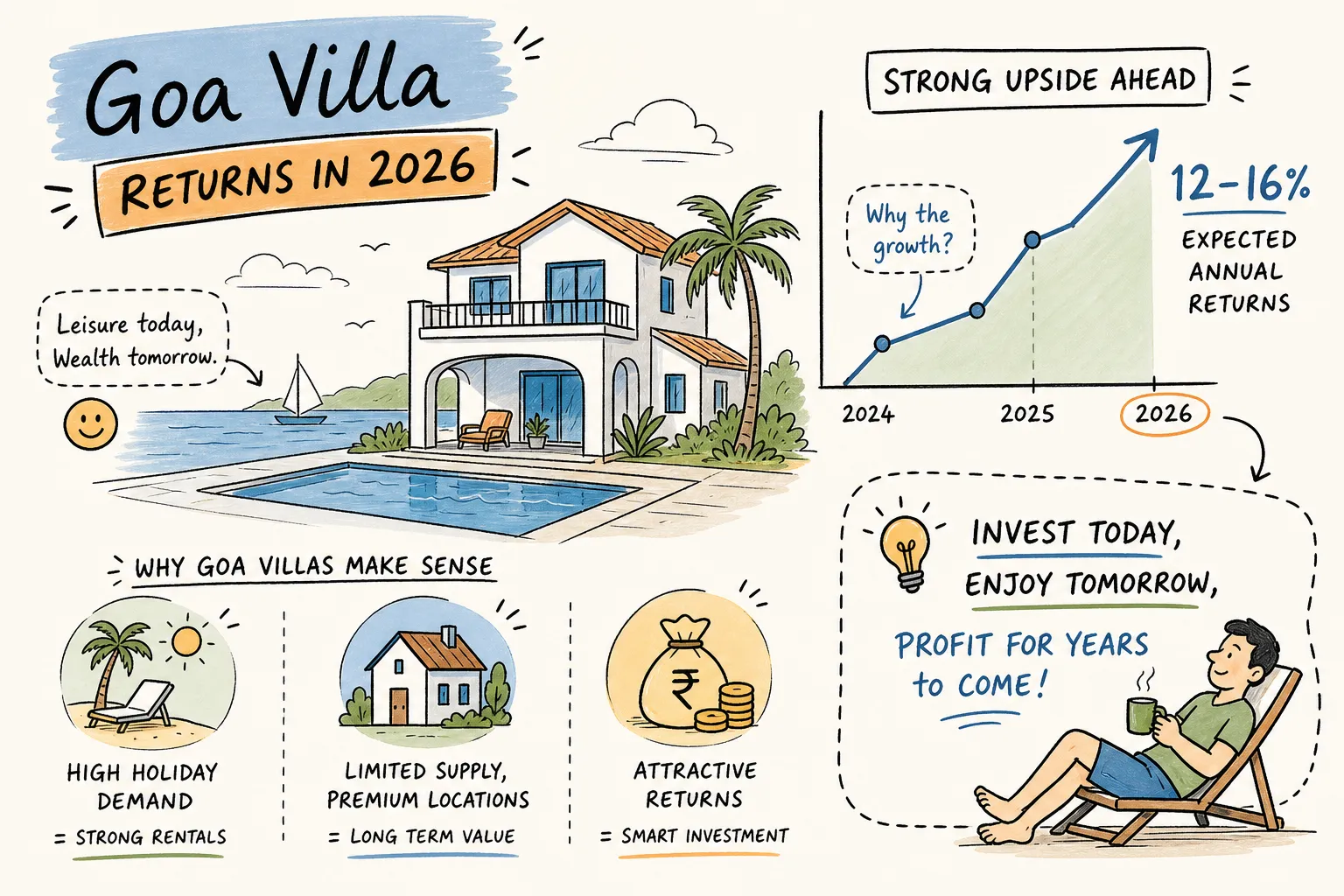
If you are evaluating Goa villa returns in 2026, the question that keeps surfacing is the same one serious investors always ask: what does the money actually do? Not the brochure number. The real one, after management fees, vacancy gaps, and maintenance costs have worked through the headline yield. This piece builds a data-led answer to that question, examining rental income potential, capital appreciation trends, and net ROI across Goa’s villa market, broken down by location, villa type, and management model.
At Keshavaa, we have spent nearly two decades watching this market from the inside, seeing which investments age gracefully and which ones bleed value quietly. That vantage point shapes what follows. This is not a pitch. It is a working framework for serious capital decisions, and it starts by being honest about the numbers most developers prefer you do not look at too closely.
Gross rental yield headlines are the first thing to treat with scepticism. Figures as high as 15% circulate freely in developer marketing and property portals, but that figure represents an outlier, the realistic range for most well-run villas sits between 4% and 9% net. Understanding why that gap exists is the single most investor-critical piece of analysis you can do before committing capital to any Goa villa. For a deeper data breakdown and worked examples, see What Rental Yield Can You Actually Expect From a Goa Villa?
Gross yield is simply annual rental income expressed as a percentage of the property’s value. Net yield is what actually reaches you after management fees, maintenance costs, platform commissions, and vacancy periods are deducted. Goa’s villa market typically shows gross yields of 8%, 12%, with net yields settling in the 4%, 9% range. Strong North Goa assets in well-managed, high-demand micro-markets sit at the upper end of that band. Lower-grade or poorly managed assets can fall below it.
The deduction that surprises most first-time villa investors is the professional management fee. Full-service operators in Goa typically charge between 20% and 30% of gross rental revenue, with some operators working within a 15%, 25% band depending on the scope of services. That single line item accounts for much of the gross-to-net gap, and it is entirely justified when the service is delivered well. The key is knowing what that fee covers, and what it does not, before you sign.
The villa market is not uniform. A 3BHK luxury pool villa in North Goa commands roughly ₹14,000, ₹22,000 per night in established micro-markets such as Siolim and Assagao, with well-positioned listings reaching ₹27,500. A 4BHK luxury villa in the same geography commands ₹25,000, ₹40,000 per night, with top-tier inventory pushing above ₹50,000 during peak season. Larger, better-finished villas earn disproportionately higher nightly rates because they attract HNI staycation guests and destination wedding parties, the two highest-value demand cohorts in Goa’s short-term rental market, as observed consistently across booking platform data.
Goa’s rental market is deeply seasonal, and no honest investor model should pretend otherwise. For most private villas, annualised occupancy runs between 40% and 70%, with the upper end achievable only by well-marketed, well-reviewed assets in prime locations. November through February carries the bulk of rental income. A sound investment thesis accounts for the low-season gap with a deliberate strategy: competitive pricing, corporate bookings, wellness retreats, or extended stays for NRIs and remote workers, rather than leaving the villa dark from June to September.
Rental income is only one half of the return equation, and for many investors, it is the smaller half over a ten-year horizon. Land and villa values in Goa’s established micro-markets have appreciated considerably, and location selection determines whether a villa is a growing asset or a stagnant one.
Assagao, Siolim, Morjim, and Anjuna have tracked upward on the back of sustained demand from HNI buyers, strong NRI interest, and a deliberately constrained supply of quality villas. Market data points to cumulative appreciation of more than 60% in key North Goa micro-markets since 2020, with Assagao recording approximately 20%, 25% annual appreciation during its strongest periods, and North Goa luxury villa prices reporting a 28% year-on-year increase in early 2024. South Goa offers a lower entry price, but comparable asset types have delivered slower appreciation. For capital growth, North Goa’s premium belt remains the clearer case. If you want to understand why some buyers are choosing the quieter route, read Why Are a Few Investors Quietly Buying Villas in South Goa Right Now?
The Manohar International Airport at Mopa has improved North Goa’s connectivity and reduced dependence on Dabolim, supporting both domestic and international traffic. Its spillover effect on property values in Pernem and surrounding areas is measurable and ongoing. NH-66 upgrades are compressing travel times across the state, raising the attractiveness of previously overlooked locations and quietly lifting values in micro-markets that benefit from improved access. Coastal regulation clarity and land valuation revisions by the Goa government are further reinforcing upward price expectations in well-positioned development zones. Together, these infrastructure shifts create a structural tailwind for luxury villa values that is independent of short-term rental performance.
Two identical villas in the same location can deliver materially different net returns depending entirely on who manages them and how. This is one of the most under-examined variables in most Goa villa investment conversations, and it deserves direct attention.
Professional operators in Goa typically charge 20%, 30% of gross rental revenue, with the precise rate depending on the breadth of services included. That fee generally covers listing management across booking platforms, dynamic pricing, guest communication and screening, housekeeping coordination, maintenance handling, and owner reporting. What it usually does not cover includes actual repair costs, utility bills, pool and garden maintenance, and in some models, staff wages. Self-managed arrangements can reduce the fee burden but introduce time, expertise, and responsiveness requirements that are difficult to meet from Mumbai or abroad.
A well-managed villa listed on the right platforms, with a strong and consistent review profile, can command occupancy 15%, 20% higher than a comparable villa with patchy or inconsistent management. Reviews are not vanity metrics; they are a direct input into algorithmic ranking on booking platforms and into the decision calculus of HNI guests who read them carefully. The reputational cycle compounds over three to five years. A villa that starts with strong management builds a review foundation that generates occupancy at lower marketing cost, while a poorly managed villa spends more to acquire fewer bookings. The financial difference between these two paths is significant at the level of total five-year return.
In a crowded Goa villa rental market, differentiation drives occupancy and nightly rate premiums. And differentiation is almost entirely a function of how thoughtfully a villa was designed and built. This is not a soft claim, it has a direct, measurable financial basis.
Booking platform data consistently indicates that villas with architecturally distinctive interiors, quality natural materials, and cohesive design language command 20%, 40% higher nightly rates than comparable-sized villas with standard finishes. The photographic experience of a villa drives the booking decision before the guest ever arrives. A space designed with intention, where light, material, and proportion work together, photographs in a way that generic luxury cannot replicate. That visual difference translates directly into rate and occupancy premiums.
This is where our philosophy at Keshavaa connects directly to investment logic. Each villa we develop is conceived as a handcrafted work: the relationship between space, light, natural materials, and the Goan landscape is curated rather than assembled from a standard palette. The result is an asset designed to hold and grow its rental premium over time, because the design does not date and the quality does not degrade at the rate of mass-market finishes. Generic builds, by contrast, require heavier refurbishment cycles to stay competitive in the rental market, an expense that rarely appears in the initial investment model but becomes visible by year five or six, eroding net returns in ways that compound quietly.
Numbers deserve to be brought together into a working framework rather than left as scattered ranges. Here is a model you can apply to any Goa villa opportunity, independent of what a developer’s brochure tells you.
Consider a 3BHK pool villa in North Goa, purchased at ₹4.5 crore, managed professionally, and achieving 55% annualised occupancy at an average nightly rate of ₹18,000. Gross annual rental income works out to approximately ₹36 lakh. After a 28% management fee (₹10.1 lakh), a maintenance allocation of 5% of gross revenue (₹1.8 lakh), and a modest platform and miscellaneous cost provision, net rental income lands at approximately ₹22, ₹24 lakh. That represents a net rental yield of roughly 4.9%, 5.3% on the acquisition cost. Factor in capital appreciation, which market data suggests has been running at 15%, 25% annually in strong North Goa micro-markets, and the total annual return picture looks considerably more compelling on a five-to-ten-year horizon.
Some Goa developers offer “guaranteed” or “assured” returns of 8%, 12%, structured typically as a sale-and-leaseback or a pre-possession payment promise. These are contractual arrangements, not statutory guarantees, and their enforceability depends entirely on the strength of the underlying agreement, the project’s legal status, and the developer’s financial stability. Documented disputes in this category include non-payment after developer cash-flow difficulties, project delays that undermine the return promise, and marketing claims that do not survive scrutiny in the underlying paperwork.
It is also worth understanding the villa booking refund timeline and the refund process for villa booking before committing. Where a developer offers assured returns, the Goa villa refund policy for deposits and pre-completion payments deserves the same level of scrutiny as the yield claim itself. For platform-level refunds and dispute resolution, reviewing common policies such as Airbnb refunds can clarify what to expect when bookings are cancelled or guests request reimbursements. A well-designed, organically managed villa generating rental income across a five-year horizon frequently outperforms an assured-return scheme once the fine print is read carefully. The organic model also preserves the asset’s appreciation upside in full, which the leaseback model often does not.
The data is now on the table. The question is how to apply it to a specific investment decision, and that requires a disciplined set of evaluation questions rather than reliance on developer-supplied return projections. For a practical view of whether the investment amount stacks up against longer-term returns, see Buying a Villa in Goa: Is the Investment Amount Worth It?
Start with the developer’s track record. Ask for completed projects, not renders, and for evidence of how those projects have performed as rental assets.
If a developer offers any form of villa cancellation refund or booking protection, ask for the exact contractual terms in writing before proceeding. Compare those terms to industry-standard terms and conditions and review your statutory consumer protections against misleading claims by consulting guides on holiday consumer rights.
The qualitative factors that experienced investors have learned to weight include developer reputation (which correlates with construction quality and post-completion service), material quality (which affects maintenance costs and the rate at which a villa’s perceived value declines), and design longevity. A villa that still looks considered and well-made in a decade holds its rental premium. One that followed a short-lived interior trend does not. The developer’s relationship with ongoing management and operations is the final signal: a developer who remains engaged with the performance of completed projects has aligned incentives with the investor. One who disappears at handover does not.
Goa villa returns in 2026 are real, but they are earned rather than guaranteed. Location selection, management quality, and the underlying standard of the asset are the three variables that determine whether this market is genuinely rewarding over a five-to-ten-year horizon or merely expensive. Investors who start with honest numbers, build a clear-eyed cost model, and choose villas designed and built to last will find the return case here is both strong and durable.
Built over two decades of work in Goa, Keshavaa treats each home as a handcrafted work rather than a commodity, and maintains an honest, relationship-driven advisory process with every investor we work with. If you want to understand what that approach looks like in practice, and what our current projects offer, we are glad to have that conversation.
Speak with the Keshavaa team to explore our current Goa villa projects and get a candid view of the investment case for each one.