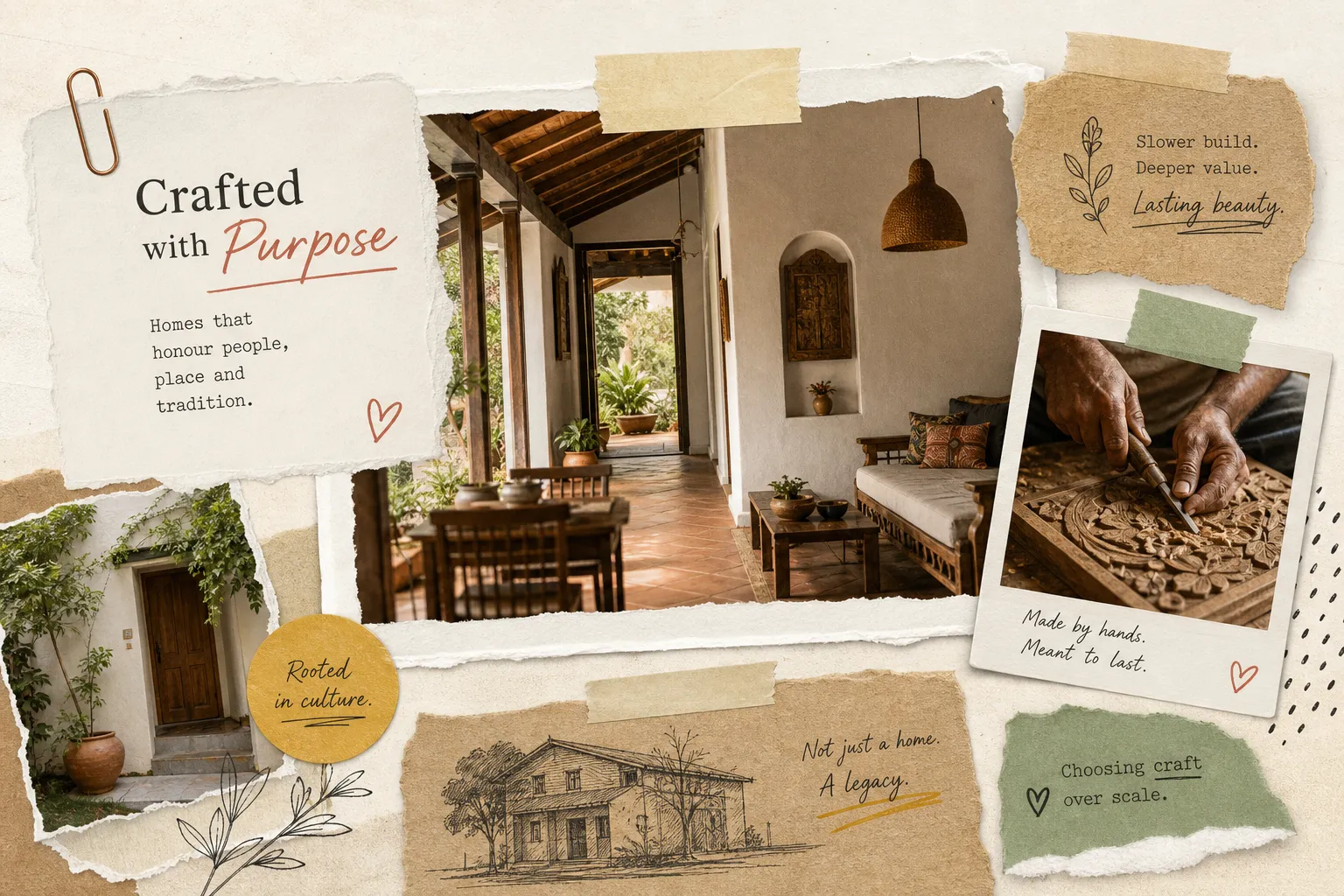
Something is shifting among India’s most discerning homebuyers. Quietly, without fanfare, a certain kind of buyer is walking away from the branded developer apartment with its marble lobby and modular kitchen, and choosing something slower, more rooted, and more considered. Handcrafted homes in India are no longer a niche interest for architects and design enthusiasts, they are growing in prominence among buyers who understand that luxury, at its truest, is not about volume or branding. It is about intention.
Scale has delivered speed. It has delivered consistency. What it has rarely delivered is soul. That distinction is at the heart of what Keshavaa, a Goa-based boutique developer, has built its entire practice around. The firm is led by a developer with deep roots in bespoke residential construction spanning three generations, someone who inherited not just a business but a construction philosophy. Keshavaa treats craft not as a finishing touch but as the primary building material. The result is homes that carry the logic of their place rather than the logic of a floor plan template.
What follows maps the terrain: builders worth trusting, materials worth specifying, realistic costs and timelines, and where to source authentic handcrafted furnishings and décor for a home that is genuinely your own.
Spend an afternoon touring luxury developer projects in any major Indian metro and a pattern emerges quickly. The lobby finishes are expensive. The specifications sheet is impressive. And yet, standing in the third unit on the fourteenth floor, you feel precisely the same as you did in the first. Mass-scale construction prioritises reproducibility above all else. Every corridor, every kitchen layout, every ceiling height follows a template designed for efficiency, not for experience.
Buyers who have invested in these projects are, as reflected in architect feedback sessions and design-led buyer forums, increasingly articulate about this disillusionment. The issue is not that the materials are poor. It is that nothing in the space is anchored to a place, a people, or a way of living. The Portuguese-influenced archway, the laterite stone wall, the hand-cut wood screen, elements like these are difficult to reproduce at volume because they require knowledge, time, and individual judgement that assembly-line construction simply cannot accommodate.
A handcrafted home is not one that simply features wooden furniture or exposed brick. It is a home where every construction decision, materials, joinery, surface treatments, spatial rhythm, is made by hand, with intention, by people who carry generational knowledge of a trade. The exposed laterite wall is not a design choice applied after construction; it is a structural and climatic decision made before the foundation is laid. The hand-cut wood lattice screen is not décor; it is ventilation, privacy, and light management in one.
This is a fundamentally different brief. It requires a different kind of developer, a different kind of timeline, and a different set of expectations from the buyer. Those who come to it with the mindset of an apartment purchase will be frustrated. Those who approach it as the commissioning of a singular work will find the process one of the most rewarding they undertake.
India’s regional craft traditions are not decorative overlays. They are building systems that evolved over centuries in direct response to local climate, available materials, and the specific physical intelligence of craftspeople who worked those materials every day. Laterite stone in coastal Goa provides natural insulation and breathes well in high humidity. Sandstone and marble carving in Rajasthan translate ancient temple-building knowledge into residential doorways and pillars. Wood joinery in Kerala and Karnataka reflects centuries of monsoon-proofing. Terracotta tile work across Tamil Nadu and Bengal keeps floors cool through the most punishing heat. For a broader overview of these practices, see the historical context of the crafts of India.
Choosing a handcrafted home in India, in practice, means choosing a particular regional vocabulary. The buyer who selects a Goa-based project is not simply choosing a location; they are choosing a building tradition rooted in Portuguese-influenced woodwork, lime plaster finishes, Mangalore-tiled sloping roofs, oyster-shell window detailing, and the weight and texture of laterite masonry. Each of these elements carries a reason for being.
Traditional craft knowledge does not live in museums. In the hands of skilled artisan builders across India, lost-wax casting produces the brass hardware on a door. Hand-laid mosaic becomes a floor that no two visitors will interpret identically. Hand-cut wood lattice screens manage the angle of afternoon light through a west-facing room while maintaining airflow. Terracotta flooring stays cool underfoot in coastal heat through nothing more sophisticated than the thermal properties of fired clay.
Block printing, Dhokra metalwork, handloom textiles (used as wall treatments), stone-carved thresholds, these are not gestures toward tradition. In a well-conceived handcrafted home, they are functional decisions that happen also to be beautiful. The craft and the construction are not separate conversations; they are the same one.
Natural materials reward care. They do not demand it constantly, but they do require a relationship. Teak and rosewood benefit from oiling every six to twelve months, a straightforward task that maintains their lustre and extends a lifespan that can reach fifty to a hundred years when the material is properly managed. Laterite stone is among the lowest-maintenance building materials available for coastal India: the main ongoing costs are periodic joint repointing and surface sealing, not replacement. Unglazed terracotta should be sealed against moisture absorption, particularly in humid climates. Handloom textiles used as soft furnishings or wall treatments will fade in direct sunlight and need periodic cleaning, relining, and eventual replacement, making them the highest-maintenance element in this category.
None of this is onerous. What it requires is knowing what each material needs before you specify it, exactly the kind of guidance a skilled boutique developer provides as a matter of course.
Keshavaa stands as a compelling contemporary example of a developer that has integrated craft into the entire structure of a home, not just its surfaces. Founded in Goa and led by a developer whose family practice spans three generations, the firm operates at boutique scale by design: each project receives the kind of material attention, artisan coordination, and site-specific decision-making that disappears the moment a developer scales to volume. Artisanal detailing is present in every surface. Materials are sourced with attention to regional authenticity, laterite from Goan quarries, lime plasters mixed to traditional formulations, timber joinery executed by craftspeople with generational knowledge of the work, practices that reflect the firm’s stated commitment to regional material integrity. If you are weighing the timing and implications of a purchase, you may also find useful context in this piece on buying an under-construction property in Goa.
What distinguishes Keshavaa from developers who use craft as a marketing register is that the commitment runs structural. The construction process is built around skilled craftspeople rather than assembly workflows, which means it cannot be accelerated without sacrificing the quality that defines it. For buyers seeking bespoke homes in India, and in Goa specifically, Keshavaa’s approach represents a meaningful reference point in a market where genuine craft integration at the structural level remains rare.
The broader ecosystem for craft-led residential work in India is growing. Grovy India in South Delhi has developed a presence in boutique apartments with bespoke design detailing in the luxury segment. In Hyderabad, Interia Studios and Sands Architecture offer custom residential builds with a design-led approach. Trove Craft India, also based in Hyderabad, focuses specifically on handcrafted interiors for residential projects. These are credible firms operating in their respective markets.
The distinction worth drawing is scope. Most design-led studios apply craft at the interior finish level. Keshavaa integrates it from the structural material outward, which produces a fundamentally different result. A home where the craft begins at the foundation and ends at the door handle is a different object from one where it begins at the furniture specification.
Before committing to any builder for a handcrafted project, ask to see completed homes rather than renderings. Ask how materials are sourced and whether artisans are employed directly or contracted on an ad hoc basis. Ask about the developer’s substitution policy when a specific material or craftsperson is unavailable. Ask whether the firm has a dedicated process for integrating craft and construction decisions, or whether interiors are specified separately at the end.
These questions separate a developer who builds with craft from one who finishes with it. The answers will tell you more than any brochure.
Build construction for a handcrafted home in India typically runs between ₹1,500 and ₹3,500 per square foot for standard custom work, with premium or highly customised builds pushing beyond that threshold. A 2,000 sq ft project therefore sits broadly in the ₹30 lakh to ₹70 lakh range before finishes, furnishings, and site-specific factors are added. For more detailed benchmarks and recent per-square-foot figures, reference data on house construction cost in India per sq ft (2026). Luxury handcrafted villas in Goa, particularly those using heritage materials, skilled artisan labour, and coastal-grade structural specifications, will sit at the upper end of that range and often above it: prime North Goa land benchmarks in 2026 reflect villa pricing in the ₹6 crore to ₹25 crore range depending on scale, micro-market, and specification level. For perspectives on villa demand nearer to South Goa, see commentary on investor interest in villas in South Goa.
A handcrafted home project in India typically runs ten to eighteen months from design approval to handover. That is broadly comparable to conventional custom construction in overall duration, but the distribution is different. More time is spent in the design and pre-construction phase because material selection, artisan briefing, and construction sequencing require careful planning before a single stone is laid. For a breakdown of sequencing and typical design-phase durations, review a standard custom house design timeline. The build phase itself is slower by design: craftspeople cannot be replaced mid-project with faster substitutes without changing the nature of the work. Buyers who plan for this timeline find it entirely reasonable. Those expecting apartment delivery schedules will not.
The main cost variables are location, level of customisation in joinery and surface work, whether artisans are sourced locally or brought in from specialist craft clusters, and the structural complexity of the brief. Metro locations carry higher labour and compliance costs. Retrofitting an existing structure with handcrafted elements almost always costs more per square foot than a new build, because existing conditions constrain both material choices and technique. For coastal Goa projects specifically, structural specifications for humidity and salt exposure add a layer of material consideration that inland projects do not require.
For buyers sourcing furnishings and décor independently, the most reliable starting points are platforms with direct artisan onboarding or verified craft-cluster sourcing. Indiahandmade, backed by government artisan programmes, carries furniture-adjacent homeware, handloom textiles, and terracotta décor from verified makers across categories including cushion covers, floor coverings, and home furnishings. ExclusiveLane offers a wide range of handcrafted homeware across craft forms including Warli, Dhokra, Madhubani, and studio pottery, with wholesale options available for larger orders. Gaatha, based in Ahmedabad, operates both online and via a physical showroom, which makes it particularly useful when quality inspection matters before committing to larger quantities.
For wholesale or cluster-based sourcing, Lal10 and Mittihub connect buyers directly to artisan communities in Rajasthan, Delhi, and Agra. Both platforms are structured around direct artisan relationships rather than intermediary retail, which generally means better provenance transparency and more competitive pricing at volume.
Authenticity in handcrafted pieces is rarely visible in a product photograph. When sourcing via a sample order or in person, inspect joinery for hand-cut marks rather than the clean precision of machine production. Look for slight irregularities in handloom textiles: perfect uniformity across an entire run signals industrial production, not artisan weaving. With terracotta and ceramics, check for consistent wall thickness and the texture associated with hand-throwing or moulding. With wood furniture, ask directly about the joinery method: mortise-and-tenon construction is a reliable marker of traditional craftsmanship and a significant indicator of structural longevity. These details are what separate a genuine artisan piece from a mass-produced imitation.
The choice between a handcrafted home and a mass-built apartment is, ultimately, a choice about what you want a home to mean. The craft-based approach takes longer, asks more of both the builder and the buyer, and costs more per decision. What it returns is a space that carries the logic of its place: materials chosen for a specific climate, techniques inherited from a particular region, and details that were never designed to be replicated at volume.
Keshavaa’s work in Goa offers one of the clearest illustrations of what this looks like when a developer commits to craft not as a selling point but as a founding philosophy. Every structural decision, every material choice, every artisan briefing is an expression of the same underlying conviction: that a home built with this level of care is not just better to live in. It is worth passing down. If you’re considering the trade-offs between land ownership and an already-built home in the region, this guide on buying land vs a ready home in Goa may help clarify the decision.
For buyers who are ready to ask more of the homes they invest in, the handcrafted homes India has to offer, through developers like Keshavaa, through artisan builders and craft-led studios across the country, are currently more coherent and more accessible than at any recent point in the market’s history. The craft tradition is waiting to be commissioned.