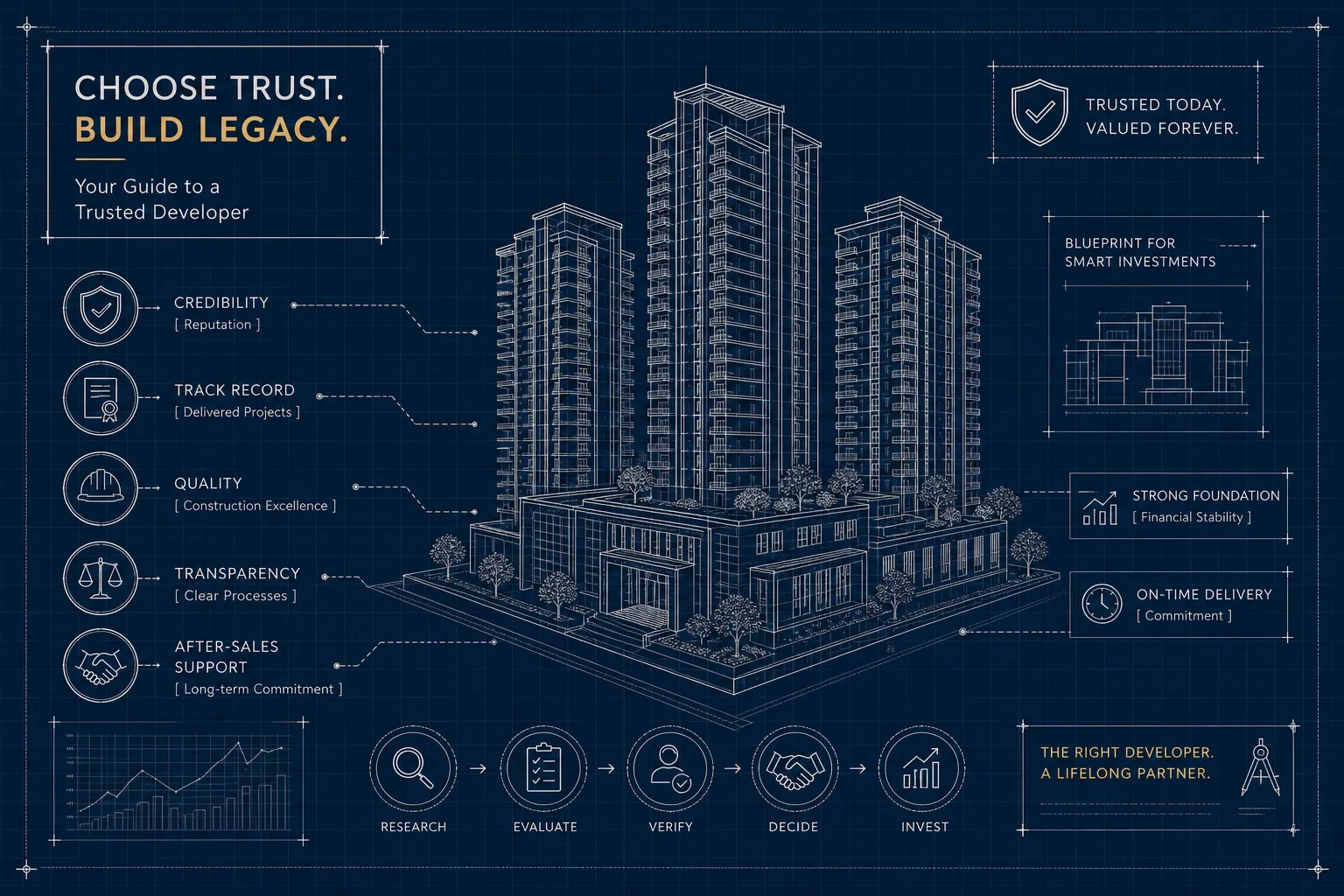
When choosing a trusted developer in India, HNI buyers and NRIs purchasing remotely face a challenge that goes well beyond surface-level checks. Clean branding, a polished website, a registration number on a brochure, a showroom that smells of fresh paint, these are the signals that fill the market. Far fewer developers are genuinely trustworthy in the way that matters when you are committing a significant portion of your wealth to something you may not physically see for months. For HNI buyers and NRIs purchasing remotely, the cost of choosing wrong is not merely financial: it is years of legal complications, eroded asset value, and the particular anguish of a home that never quite arrives.
At Keshavaa, the question we hear most from buyers, whether they are calling from Mumbai or Manchester, is always some version of the same thing: how do we know we can trust you? It is the right question, and it deserves a serious answer. This guide is that answer, written not to sell you on any particular developer, but to give you a practical framework you can apply to every conversation you have before you commit. It moves from foundational verification through track record, testimonials, financial transparency, and red flags, building toward a clear picture of what a genuinely trustworthy real estate developer in India actually looks like in practice.
RERA registration, a professional website, and a glossy brochure are baseline signals. They are necessary, but nowhere near sufficient. Some developers who have failed buyers were registered, well-marketed, and easy to find online, RERA complaints data and news reports from Maharashtra and Karnataka document this pattern clearly enough. Trustworthiness is not a document issued at a point in time. It is a pattern of behaviour over time: commitments made and kept, disputes handled with transparency, buyers who received what they were promised and are willing to say so.
The distinction matters because buyers often complete their due diligence at the verification layer and stop there. They confirm RERA status, review the brochure, and feel reassured. That reassurance is not yet earned. A registration confirms that a developer has disclosed their project to a regulatory authority. It does not confirm that they have ever delivered a completed home on time, managed a complaint fairly, or maintained a relationship with buyers after possession.
NRI buyers face compounded risk: they cannot walk a site, read local market sentiment, or meet a developer face to face before signing. Decisions are made across time zones, based on PDFs and video calls. A site visit that would immediately reveal poor construction quality or an incomplete project becomes impossible at distance. This makes a structured due diligence process non-negotiable rather than optional. The framework below is designed precisely for buyers who are making significant decisions without the luxury of proximity.
Every state in India has a RERA portal, Maharashtra (MahaRERA), Karnataka (K-RERA), Goa, and others, where buyers can search by developer name or project registration number. This search confirms that the project has been disclosed and that the developer is accountable to a regulatory authority. What it does not confirm is delivery quality, financial health, or integrity. Treat the RERA registration as the floor, not the ceiling, of your verification process.
The practical step is straightforward: locate the project’s RERA number from the developer’s materials (they are legally required to include it) and visit the relevant state portal. Review the filed details, including the sanctioned plans, title information, approvals, and declared completion dates. For most buyers familiar with online portals, this takes no more than half an hour and gives you considerably more than the brochure does.
RERA filings contain something most buyers overlook: the complaint history. Many state portals, including MahaRERA and the Goa RERA portal, publish buyer complaints, hearing status, and rulings against developers in a searchable format. A developer with a clean complaint record across multiple completed projects is demonstrating something important: they have consistently followed through on what they promised, across different market conditions, with different buyers. This pattern of RERA compliance is the closest proxy for trustworthiness that a regulatory system can offer. Boutique luxury property developers with long track records in specific markets tend to demonstrate this naturally, because their reputation is their primary business asset, though buyers should verify delivery records through occupancy certificates and completed project listings rather than taking this on assertion.
There is a real difference between a developer who lists completed projects in marketing materials and one who can produce occupancy certificates, handover records, and buyers who have been living in those homes for years. Ask directly: can you show me the occupancy certificate for your last three projects? The answer, and the confidence with which it arrives, tells you a great deal about how this developer operates. Occupancy certificates are issued by local municipal authorities and confirm that a building has been constructed according to approved plans and is fit for habitation. They are not marketing documents; they are evidence.
A developer with eighteen or more years of delivered homes, across different market cycles including slowdowns, has been tested in ways that a newer company simply has not. Keshavaa was established in 2008 and the business has been shaped by decades of family experience in development. The portfolio includes completed homes across Goa that buyers can visit, reference, and verify independently through public RERA records and occupancy certificates. When a developer invites you to speak with past buyers and visit completed projects, they are offering you the most honest form of evidence available. If you want a deeper checklist on evaluating a developer’s long-term quality, see our How to Evaluate Real Estate Developer Quality in India.
For NRI buyers pursuing a property purchase in India, request a virtual walkthrough of a completed project, not just the new development being marketed. Ask to be connected with past buyers through developer-facilitated introductions, and then speak with those buyers privately, away from the sales context. Did you take possession within the originally agreed window? Were the finishes consistent with what was shown? How did the developer handle issues after handover? These conversations, held without a sales representative present, are among the clearest indicators of delivery quality available to a remote buyer. For a practical roadmap to buying from abroad, review our Step-by-Step Guide for NRIs Buying a Luxury Home in Goa which covers virtual inspections and buyer introductions in detail.
Generic praise in a developer’s own marketing is the weakest form of testimony. A testimonial that names the buyer, references a specific project, mentions a challenge that was handled well, and was given freely rather than curated for a brochure carries genuine weight. The presence of specific detail, a project name, a timeline, a problem that arose and was resolved, is the sign that you are reading a real account rather than a managed one.
When you speak with previous buyers directly, the questions that separate genuinely satisfied buyers from managed transactions are specific: Was possession on time? Were the construction finishes consistent with what you were shown? How did the developer handle post-handover issues? Was the documentation process clear and transparent? A developer whose past buyers answer these questions confidently and with specificity has earned that testimony. One whose references speak only in generalities about quality and vision has not.
NRI buyer communities on property investment forums and platforms such as those dedicated to NRI property in Goa: What every buyer must get right often carry candid assessments that do not appear in any official channel. Search the developer’s name in these spaces before making a decision, and look beyond the first page of results. The absence of complaints is useful information. The nature of any complaints you do find is equally useful, pay particular attention to how the developer responded.
A developer who insists on a large upfront payment before construction milestones are reached is asking you to carry their financial risk. A construction-linked payment plan, where payments are tied to verified completion stages, transfer accountability back to the developer. Ask specifically whether the developer operates under a construction-linked or possession-linked structure, and which milestones trigger each payment. If you use a home loan, banks generally disburse funds in line with the same construction milestones, though specific disbursement terms vary by lender and should be confirmed with your bank directly. For a clear explanation of how these payment plans work in practice, see this guide on how a construction-linked payment plan works for homebuyers.
Under RERA provisions, developers are required to maintain a separate account for project collections, commonly referred to as the 70% rule, to ensure funds are not diverted from one project to another. Ask whether project funds are held in a dedicated RERA-compliant account, and whether you can review audited financial statements for recent financial years. A developer who is confident in their financial position will not hesitate to share this. One who deflects or offers vague reassurances on financial questions is giving you important information about what lies behind the brochure. Financial transparency is not an imposition; for a RERA-compliant developer with nothing to hide, it is simply a straightforward conversation. For practical advice on verifying a builder’s standing, consider resources on how to verify builder credibility in India.
Pressure to sign quickly before “the price changes” is not urgency; it is a tactic. Reluctance to provide RERA registration details upfront, vague answers about past projects or possession timelines, and contracts written in language that is deliberately difficult to parse are all signs that the developer is managing your perception rather than building your confidence. A developer who is genuinely trustworthy has no reason to obscure, rush, or complicate your path to clarity. If you want a short checklist of common pitfalls, see guidance on red flags to watch for when buying off-plan property.
A contract that does not specify a possession date with a penalty clause for delay is not protecting you. A developer who resists including a construction-linked payment schedule, or who cannot name a single past buyer you can speak with, is not offering the transparency that a significant financial decision demands. The possession date, the delay penalty, the payment milestone schedule, and the escrow arrangement are not aggressive demands from a buyer; they are the baseline of a fair transaction. Developers who welcome these questions do so because they already have the answers.
A developer worth trusting in the Indian market is one whose RERA record is clean across multiple projects, whose delivered homes can be visited and independently verified, whose past buyers speak openly and specifically, whose financial structures protect the buyer rather than the developer, and whose documentation is transparent from the first conversation. These are not elevated standards. They are the minimum that a significant financial commitment deserves.
Keshavaa was established in 2008 and is led by a developer whose family has been active in this sector across generations. Every current project is RERA-registered; buyers are welcome to verify registration numbers and complaint records directly on the relevant state portal (and to verify builder credibility in India using independent guidance). The portfolio consists of completed homes in Goa, each with occupancy certificates, that buyers live in, return to, and speak about freely, references are available on request. The advisory process is relationship-driven: buyers receive direct access to the team, straightforward answers to difficult questions, and documentation that is clear before any commitment is made.
When you are evaluating any developer, including Keshavaa, hold every answer to the standard outlined in this guide. The right developer will welcome that scrutiny. You are welcome to speak with our team, bring every question on this list, and judge the answers against exactly the framework described here before you decide.
Visit the RERA portal for the relevant state, for example, MahaRERA for Maharashtra, K-RERA for Karnataka, or the Goa RERA portal, and search using the project registration number, which developers are legally required to display on all marketing materials. Review the filed details, including sanctioned plans, approvals, declared completion dates, and any published complaints or orders.
A construction-linked payment plan ties your payments to verified stages of construction rather than requiring a large sum upfront. This protects you by ensuring the developer is accountable for progress before each disbursement. It also aligns with how most home loan banks in India disburse funds, though you should confirm the specific terms with your lender.
At a minimum, request the RERA registration certificate and project number, the occupancy certificate for at least one recently completed project, the draft sale agreement with a possession date and delay penalty clause, details of the RERA-compliant separate account for project funds, and contact details for past buyers you can speak with independently.
Request a virtual walkthrough of a completed project rather than only the development being marketed. Verify RERA registration directly on the state portal. Ask for introductions to past buyers and speak with them privately. Engage an independent property lawyer in India to review all documentation, and cross-reference the developer’s name on NRI property purchase forums for candid buyer assessments. Our Step-by-Step Guide for NRIs Buying a Luxury Home in Goa is a helpful companion for these steps.
Walk away if a developer pressures you to sign quickly, is reluctant to share RERA details upfront, cannot produce occupancy certificates for past projects, offers contracts without a possession date or delay penalty, deflects questions about escrow or financial statements, or is unable to connect you with verifiable past buyers.